Want to learn how to prove a theorem? Go for a mountain bike ride

Because this blogpost covers both mountain biking and proving theorems, it is being simultaneously published by the Mathematical Association of America in my Devlin’s Angle series.

FEBRUARY 1, 2014. Mountain biking is big in the San Francisco Bay Area, where I live. (In its present day form, using specially built bicycles with suspension, the sport/pastime was invented a few miles north in Marin County in the late 1970s.) Though there are hundreds of trails in the open space preserves that spread over the hills to the west of Stanford, there are just a handful of access trails that allow you to start and finish your ride in Palo Alto. Of those, by far the most popular is Alpine Road.

My mountain biking buddies and I ascend Alpine Road roughly once a week in the mountain biking season (which in California is usually around nine or ten months long). In this post, I’ll describe my own long struggle, stretching over many months, to master one particularly difficult stretch of the climb, where many riders get off and walk their bikes.

[SPOILER: If your interest in mathematics is not matched by an obsession with bike riding, bear with me. My entire account is actually about how to set about solving a difficult math problem, particularly proving a theorem. I’ll draw the two threads together in a subsequent post, since it will take me into consideration of how the brain works when it does mathematics. For now, I’ll leave the drawing of those conclusions as an exercise for the reader! So when you read mountain biking, think math.]

Alpine Road used to take cars all the way from Palo Alto to Skyline Boulevard at the summit of the Coastal Range, but the upper part fell into disrepair in the late 1960s, and the two-and-a-half-mile stretch from just west of Portola Valley to where it meets the paved Page Mill Road just short of  Skyline  is now a dirt trail, much frequented by hikers and mountain bikers.

Alpine Road. The trail is washed out just round the bend

A few years ago, a storm washed out a short section of the trail about half a mile up, and the local authority constructed a bypass trail. About a quarter of a mile long, it is steep, narrow, twisted, and a constant staircase of tree roots protruding from the dirt floor. A brutal climb going up and a thrilling (beginners might say terrifying) descent on the way back. Mountain bike heaven.

There is one particularly tricky section right at the start. This is where you can develop the key abilities you need to be able to prove mathematical theorems.

So you have a choice. Read Polya’s classic book, or get a mountain bike and find your own version of the Alpine Road ByPass Trail. (Better still: do both!)

My mountain bike at the start of the bypass trail

When I first encountered Alpine Road Dirt a few years ago, it took me many rides before I managed to get up the first short, steep section of the ByPass Trail.

What lies around that sharp left-hand turn?

It starts innocently enough – because you cannot see what awaits just around that sharp left-hand turn.

The short, narrow descent

After you have made the turn, you are greeted with a short narrow downhill. You will need it to gain as much momentum as you can for what follows.

I’ve seen bikers with extremely strong leg muscles who can plod their way up the wall that comes next, but I can’t do it that way. I learned how to get up it by using my problem-solving/theorem-proving skills.

The first thing was to break the main problem – get up the insanely steep, root strewn, loose-dirt climb – into smaller, simpler problems, and solve those one at a time. Classic Polya.

But it’s Polya with a twist – and by “twist” I am not referring to the sharp triple-S bend in the climb. The twist in this case is that the penalty for failure is physical, not emotional as in mathematics. I fell off my bike a lot. The climb is insanely steep. So steep that unless you bend really low, with your chin almost touching your handlebar, your front wheel will lift off the ground. That gives rise to an unpleasant feeling of panic  that is perhaps not unlike the one that many students encounter when faced with having to prove a theorem for the first time.

Steep. If you are not careful, your front wheel will lift off the ground.

The photo above shows the first difficult stretch. Though this first sub-problem is steep, there is a fairly clear line to follow to the right that misses those roots, though at the very least its steepness will slow you down, and on many occasions will result in an ungainly, rapid dismount. And losing momentum is the last thing you want, since the really hard part is further up ahead, near the top in the picture.

Also, do you see that rain- and tire-worn groove that curves round to the right just over half way up – just beyond that big root coming in from the left? It is actually deeper and narrower than it looks in the photo, so unless you stay right in the middle of the groove you will be thrown off line, and your ascent will be over. (Click on the photo to enlarge it and you should be able to make out what I mean about the groove. Staying in the groove can be tricky at times.)

Still, despite difficulties in the execution, eventually, with repeated practice, I got to the point of  being able to negotiate this initial stretch and still have some forward momentum. I could get up on muscle memory. What was once a series of challenging problems, each dependent on the previous ones, was now a single mastered skill.

[Remember, I don’t have super-strong leg muscles. I am primarily a road bike rider. I can ride for six hours at a 16-18 mph pace, covering up to 100 miles or more. But to climb a steep hill I have to get off the saddle and stand on the pedals, using my body weight, not leg power. Unfortunately, if you take your weight off the saddle on a mountain bike on a steep dirt climb, your rear wheel will start to spin and you come to a stop – which on a steep hill means jump off quick or fall. So I have to use a problem solving approach.]

Once I’d mastered the first sub-problem, I could address the next. This one was much harder. See that area at the top of the photo above where the trail curves right and then left? Here is what it looks like up close.
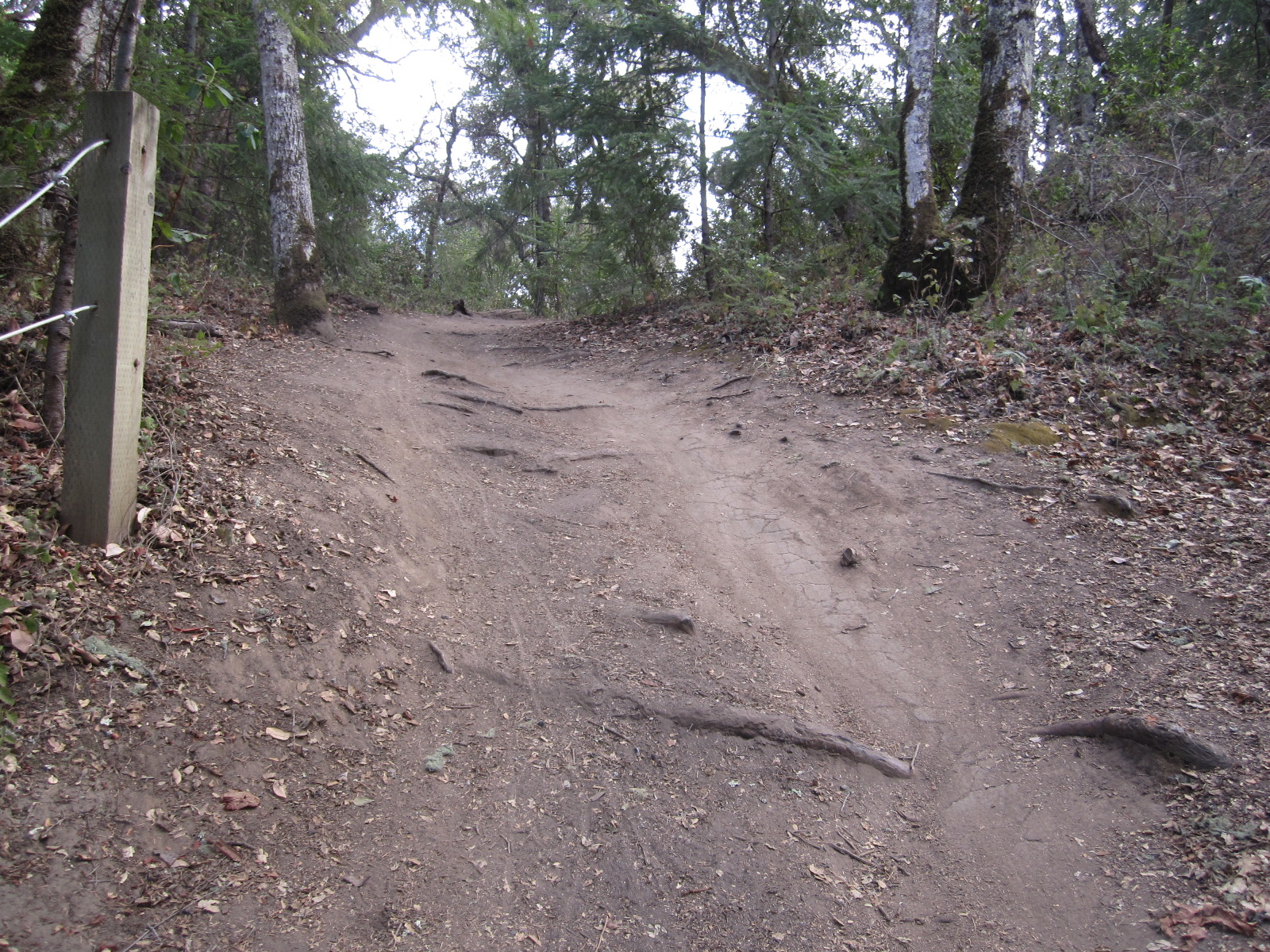
The crux of the climb/problem. Now it is really steep.
The crux of the climb/problem. Now it is really steep.

(Again, click on the photo to get a good look. This is the mountain bike equivalent of being asked to solve a complex math problem with many variables.)

Though the tire tracks might suggest following a line to the left, I suspect they are left by riders coming down. Coming out of that narrow, right-curving groove I pointed out earlier, it would take an extremely strong rider to follow the left-hand line. No one I know does it that way. An average rider (which I am) has to follow a zig-zag line that cuts down the slope a bit.

Like most riders I have seen – and for a while I did watch my more experienced buddies negotiate this slope to get some clues – I start this part of the climb by aiming my bike between the two roots, over at the right-hand side of the trail. (Bottom right of picture.)

The next question is, do you go left of that little tree root nipple, sticking up all on its own, or do you skirt it to the right? (If you enlarge the photo you will see that you most definitely do not want either wheel to hit it.)

The wear-marks in the dirt show that many riders make a sharp left after passing between those two roots at the start, and steer left of the nobbly root protrusion. That’s very tempting, as the slope is notably less (initially). I tried that at first, but with infrequent  success. Most often, my left-bearing momentum carried me into that obstacle course of tree roots over to the left, and though I sometimes managed to recover and swing  out to skirt to the left of that really big root, more often than not I was not able to swing back right and avoid running into that tree!

The underlying problem with that line was that thin looking root at the base of the tree. Even with the above photo blown up to full size, you can’t really tell how tricky an obstacle it presents at that stage in the climb. Here is a closer view.

The obstacle course of tree roots that awaits the rider who bears left

If you enlarge this photo, you can probably appreciate how that final, thin root can be a problem if you are out of strength and momentum. Though the slope eases considerably at that point, I – like many riders I have seen – was on many occasions simply unable make it either over the root or circumventing it on one side – though  all three options would clearly be possible with fresh legs. And on the few occasions I did make it, I felt I just got lucky – I had not mastered it. I had got the right answer, but I had not really solved the problem. So close, so often. But, as in mathematics, close is not good enough.

After realizing I did not have the leg strength to master the left-of-the-nipple path, I switched to taking the right-hand line. Though the slope was considerable steeper (that is very clear from the blown-up photo), the tire-worn dirt showed that many riders chose that option.

Several failed attempts and one or two lucky successes convinced me that the trick was to steer to the right of the nipple and then bear left around it, but keep as close to it as possible without the rear wheel hitting it, and then head for the gap between the tree roots over at the right.

After that, a fairly clear left-bearing line on very gently sloping terrain takes you round to the right to what appears to be a crest. (It turns out to be an inflection point rather than a maximum, but let’s bask for a while in the success we have had so far.)

Here is our brief basking point.
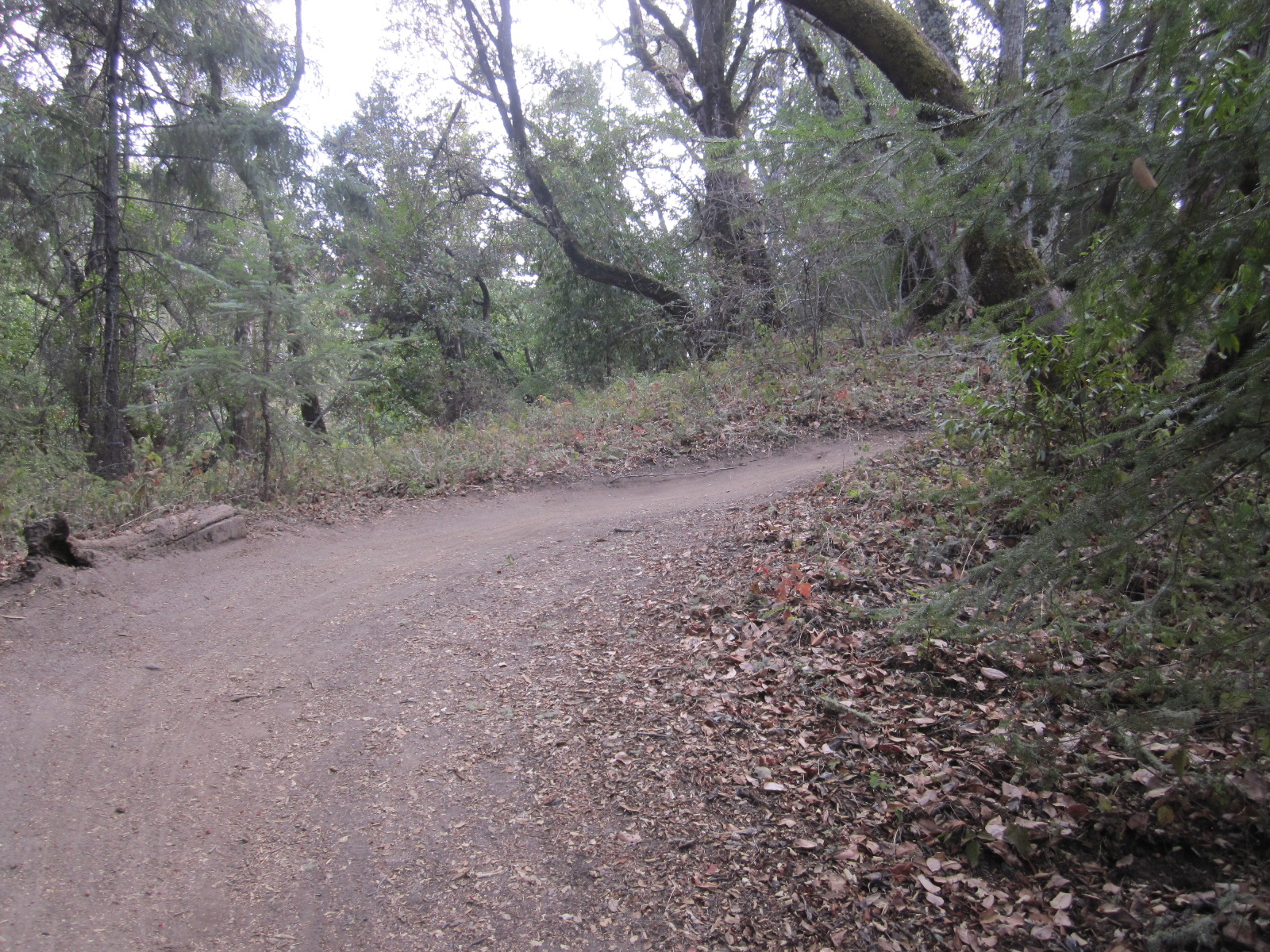
AD8
The inflection point. One more detail to resolve.

As we oh-so-briefly catch our breath and “coast” round the final, right-hand bend and see the summit ahead, we come – very suddenly – to one final obstacle.

AD9
The summit of the climb

At the root of the problem (sorry!) is the fact that the right-hand turn is actually sharper than the previous photo indicates, close to a switchback. Moreover, the slope kicks up as you enter the turn. So you might not be able to gain sufficient momentum to carry you over one or both of those tree roots on the left that you find your bike heading towards. And in my case, I found I often did not have any muscle strength left to carry me over them by brute force.

What worked for me is making an even tighter turn that takes me to the right of the roots, with my right shoulder narrowly missing that protruding tree trunk. A fine-tuned approach that replaces one problem (power up and get over those roots) with another one initially more difficult (slow down and make the tight turn even tighter).

And there we are. That final little root poking up near the summit is easily skirted. The problem is solved.

To be sure, the rest of the ByPass Trail still presents several other difficult challenges, a number of which took me several attempts before I achieved mastery. Taken as a whole, the entire ByPass is a hard climb, and many riders walk the entire quarter mile. But nothing is as difficult as that initial stretch. I was able to ride the rest long before I solved the problem of the first 100 feet. Which made it all the sweeter when I finally did really crack that wall.

Now I (usually) breeze up it, wondering why I found it so difficult for so long.

Usually? In my next post, I’ll use this story to talk about strategies for solving difficult mathematical problems. In particular, I’ll look at the role of the subconscious in being able to put together a series of mastered steps in order to solve a big problem. For a very curious thing happened after I took the photos to illustrate this post. I walked back down to collect my bike from the ByPass sign where I’d left it, and rode up to continue my ride.

It took me four attempts to complete that initial climb!

And therein lies one of the biggest secrets of being able to solve a difficult math problem.

To be continued …

The Wuzzits – Free at Last

In which the word free has several meanings.

SEPTEMBER 3, 2013. As regular readers of this blog will know, I’ve been looking at, thinking about, reflecting on, writing about, and playing video games for many years. I’ve also been working on creating my own video games, working with a small group of highly talented individuals at a company I co-founded a couple of years ago, InnerTube Games, to create high quality casual games that embody mathematical concepts and procedures in a fundamental way.

[ADDED LATER: We renamed the company BrainQuake (brainquake.com) ]

Earlier this year, in an article in American Scientist magazine, I said a little bit about the simple (though to some surprising) metaphor for learning mathematics that guides our design, and provided a screen-shot first glimpse of our pending initial release: Wuzzit Trouble. I also discussed a few other video games that adopted a similar approach to the design of games designed to develop mathematical thinking ability – rather than the  rote practice of basic skills that the vast majority of “math ed video games” focus on.

A screen shot from Wuzzit Trouble

Last week, a bit later than the release date published American Scientist, we were finally able to release our game, Wuzzit Trouble.  In our game, the aim is to use increasingly sophisticated analytic thinking to help the cute little Wuzzit characters break free from the traps they have got caught in.

When the game broke free from Apple’s clutches, a free download was all that was required for players from ages 8 to 80 to get to work freeing the Wuzzits. That’s three uses of “free”. A fourth was our approach broke free of the familiar tight binding between mathematical thinking and the manipulation of symbols on a page. (See my February 2012 post on this blog.)

One of our greatest worries was that many people think that mathematical thinking is the manipulation of symbols on a page according to specific rules. (My Stanford colleague, Professor Jo Boaler, has studied this phenomenon. See for example, my account of her work in an article for the Mathematical Association of America.) For anyone with that view, our game would not appear to offer anything particularly new or different. That would mean they would fail to grasp the power of our design metaphor, as I had described in my American Scientist article and in a short video (3 min) we released at the same time as the game.

That will likely be a problem we continue to face. It will, I fear, mean that some people we would like to reach will dismiss our game. (On one remarkable occasion, an anonymous reviewer of a funding application we submitted to cover the development costs of our game, after playing an early prototype, declared that there was not enough mathematical content. All I can say to anyone who thinks that is, give the game a try and see how far you get – see later for the fine print that accompanies that challenge.)

Fortunately, the first review of our game, published in Forbes on the day Apple released it in the App Store,  was written by an educational technology writer who understood fully what we are doing. That initial review set the tone for many follow-up articles. We were off to a good start.

We were also greatly helped by Apple’s decision to feature our game, which appeared front and center on the App Store website for educational apps.

Apple features Wuzzit Trouble on its release

Other websites that track and report on the apps world followed suit, and before long we found ourselves in the Top Fifty of new educational apps. People seemed to “get it.”

Presenting a mathematics video game that does not have equations, formulas, or other symbolic mathematics all over the screen is just one way we are different from the vast majority of math learning games. Another is that we built the game to allow players of different ages and mathematical abilities to be able to enjoy the game.

As I describe at the end of another short video, if all you want to do is free all the Wuzzits, all you need is basic whole number arithmetic, which means the game can provide a young child lots of practice with basic number work.

But if someone older wants to get lots of stars and bonus points as well, much more effort is required. (Just check out the solution to one of the puzzles I describe on that video.) This is what we mean when we say Wuzzit Trouble provides a challenge to any player between the ages 8 and 80.

But this is already way too much text. Writing about video games is like writing movie reviews. Both are designed to be experienced, not read about. Just download the game and try it for yourself. And if you are so inclined, take me up on The Math Guy Challenge.

For more details about InnerTube Games and Wuzzit Trouble, visit our website: http://innertubegames.net.

Faulty logic in the new Math Wars skirmish

JUNE 19, 2013. Mathematicians love puzzling about self-referential statements such as “This sentence is false” (ask yourself if it is true or false and see what happens), and analyzing them has led to significant insights in the way mathematics is used to model real world phenomena. But I suspect the authors of a recent New York Times opinion piece did not see the ironical self-reference in their title The Faulty Logic of the ‘Math Wars’, published on June 16.

If ever there were an article that repeatedly utilized faulty logic, this was it. Evidently written from an advocacy viewpoint, the authors obviously got carried away, allowing their advocacy position to stretch and twist logic well beyond breaking point.

I don’t normally comment on math ed advocacy articles, since people tend to be so firmly entrenched in their position that no amount of evidence and reasoning will prompt them to reflect. But this particular article was so far off the mark, and the logic so abused, I could not resist picking up my teacher’s red pen and going through it paragraph by paragraph, annotating as I did.

(Actually I generally use a green pen, since red is known to have negative consequences on student motivation. In this case, the two authors are accomplished academics, well able to handle the back and forth of scholarly debate, where we attack one another’s ideas but not the people, so ink color is not an issue. Besides, for this medium I worked at a keyboard, using boldface to signify my comments to their normal-typeface article.)

So, original article in regular type, my commentary in bold. Here we go. (It’s long, as was the original article, much of which I have to quote in order to critique it.)

* * *   * * *   * * *

There is a great progressive tradition in American thought that urges us not to look for the aims of education beyond education itself. Teaching and learning should not be conceived as merely instrumental affairs; the goal of education is rather to awaken individuals’ capacities for independent thought. Or, in the words of the great progressivist John Dewey, the goal of education “is to enable individuals to continue their education.”

This vision of the educational enterprise is a noble one. It doesn’t follow, however, that it is always clear how to make use of its insights. If we are to apply progressive ideals appropriately to a given discipline, we need to equip ourselves with a good understanding of what thinking in that discipline is like. This is often a surprisingly difficult task. For a vivid illustration of the challenges, we can turn to raging debates about K-12 mathematics education that get referred to as the “math wars” and that seem particularly pertinent now that most of the United States is making a transition to Common Core State Standards in mathematics.

At stake in the math wars is the value of a “reform” strategy for teaching math that, over the past 25 years, has taken American schools by storm. Today the emphasis of most math instruction is on — to use the new lingo — numerical reasoning.

No. Numerical reasoning is just one aspect of math instruction. Analytic reasoning, logical reasoning, relational reasoning, and conceptual understanding are just as important and equally stressed. The basic components of K-12 education were elaborated at length by a blue ribbon panel of experts assembled by the National Academies of Science in a 2001 National Academies Press volume titled Adding It Up: Helping Children Learn Mathematics

This is in contrast with a more traditional focus on understanding and mastery of the most efficient mathematical algorithms.

What is meant by “efficient” here? For many centuries, it was a crucial ability to be able to carry out numerical computations in the head or by paper-and-pencil. The “standard algorithms” were developed in India in the first centuries of the Current Era, and further honed by traders and engineers in the Iraq-Persia region, in order to make mental paper-and-pencil calculation most efficient. (The medium then was either a smooth patch of sand, a sandbox, a parchment, or some form of tablet.) 

Those standard algorithms sacrificed ease of understanding in favor of computational efficiency, and that made sense at the time. But in today’s world, we have cheap and readily accessible machines to do arithmetical calculations, so we can turn the educational focus on understanding the place-value system that lies beneath those algorithms, and develop the deep understanding of number and computation required in the modern world, and prepare the ground for learning algebra.

A mathematical algorithm is a procedure for performing a computation. At the heart of the discipline of mathematics is a set of the most efficient — and most elegant and powerful — algorithms for specific operations.

“At the heart of the discipline”! Totally untrue. This reduces mathematics to computational arithmetic. The standard arithmetical algorithms were developed by, and for, traders, to facilitate commercial activity. Those algorithms were never at the heart of mathematics, not even when they were developed. Anyone who says this, exhibits so little knowledge of what mathematics is, they should not purport to be sufficiently expert to pontificate on mathematics education.

The most efficient algorithm for addition, for instance, involves stacking numbers to be added with their place values aligned, successively adding single digits beginning with the ones place column, and “carrying” any extra place values leftward.

Actually, these are only the most (computationally) efficient algorithms if the computation is done using paper-and-pencil. For mental calculation, left-right algorithms are far more efficient. But this is a red herring, since the focus in education should be learning and understanding, and there are algorithms that are far more efficient in achieving those goals.

What is striking about reform math is that the standard algorithms are either de-emphasized to students or withheld from them entirely.

De-emphasized, yes, for the reason I alluded to above.  The need for a strong focus on those particular algorithms evaporated with the dawn of the computer age. No good teacher would withhold mention or discussion of the standard algorithms, not least because they have huge historical significance. That last remark of the authors is simply not true (though I dare say you could find the occasional teacher who acted is such a way).

In one widely used and very representative math program — TERC Investigations — second grade students are repeatedly given specific addition problems and asked to explore a variety of procedures for arriving at a solution. The standard algorithm is absent from the procedures they are offered.

Note that this is what is done in the second grade, when students are just starting out on their mathematical learning.

Students in this program don’t encounter the standard algorithm until fourth grade, and even then they are not asked to regard it as a privileged method.

So much for the authors’ earlier assertion about the standard algorithms being withheld! As to those algorithms not being treated as privileged methods, that is as it should be in today’s world. They were (rightly) privileged for many centuries when calculation had to be done by hand. But those days are gone.

The battle over math education is often conceived as a referendum on progressive ideals, with those on the reform side as the clear winners. This is reflected, for instance, in the terms that reformists employ in defending their preferred programs. The staunchest supporters of reform math are math teachers and faculty at schools of education.

Just stop and think about this for a moment. Where would you expect to find people who know most about mathematics education? Dare I say, math teachers and faculty at schools of education? By way of analogy, consider this statement. “The staunchest supporters of the need for cleanliness and the use of improved medical procedures are the doctors and nurses who work in hospitals.” You don’t say! If you get sick, you consult a medical professional – someone who has spent years studying the subject and has demonstrated their knowledge and ability. Why not proceed in the same fashion when it comes to education?

While some of these individuals maintain that the standard algorithms are simply too hard for many students, most take the following, more plausible tack. They insist that the point of math classes should be to get children to reason independently, and in their own styles, about numbers and numerical concepts. The standard algorithms should be avoided because, reformists claim, mastering them is a merely mechanical exercise that threatens individual growth.

This is such a blatant misrepresentation, I am suspicious of the authors’ motives in writing this. The standard approach in current beginning mathematics education is to begin by providing opportunities for children to reason independently (a hugely valuable ability in today’s world!), and then introduce algorithms, starting with algorithms designed for educational efficiency, and then moving on to algorithms optimized for hand-calculation efficiency. (It is arguable that it would make sense in today’s world to spend some time also looking at the algorithms used by computers, since they are not the standard paper-and-pencil algorithms, and comparison of different algorithms can help students gain deep understanding of number and computation. That could perhaps come later in the educational journey.)

The authors end the paragraph by repeating once more their false claim that “the standard algorithms should be avoided”. The “threatening growth” comment would have substance if mechanical mastery of the standard algorithms were the students’ only exposure to computational methods. But they are not.

The idea is that competence with algorithms can be substituted for by the use of calculators, and reformists often call for training students in the use of calculators as early as first or second grade.

No they do not. I do not know a single teacher who advocates calculator use in the second grade. I can’t say with certainty that you won’t find a self-proclaimed “reformist” who has made such a call, but it definitely is not “often”.

Reform math has some serious detractors. It comes under fierce attack from college teachers of mathematics, for instance, who argue that it fails to prepare students for studies in STEM (science, technology, engineering and math) fields.

You can find (a few) college professors who say evolution is false, but they are not in the mainstream. College professors enjoy enormous freedom in what and how they teach, so you can find all kinds of examples. But as someone whose career is almost exclusively spent in academia, who travels extensively and meets other academics across the US and around the world, I have yet to meet anyone who argues strongly that reform math fails to prepare students for studies in STEM. What I do hear a lot is complaints about a lot (not all) of K-12 education failing to prepare students adequately. My sense is the problem is quality of teaching as much if not more than curriculum, though the two are not necessarily independent.

These professors maintain that college-level work requires ready and effortless competence with the standard algorithms and that the student who needs to ponder fractions — or is dependent on a calculator — is simply not prepared for college math.

The first part of this statement is totally false. (Unless the phrase “these professors” refers to a couple of professors the authors happen to know.) Familiarity with the standard algorithms plays no role in college STEM. To say mastery of those particular algorithms is crucial to STEM is like saying using a Mac better prepares you for STEM than using a PC. Having a good sense of, and facility with, number, including fractions, is absolutely vital, and the algorithms currently taught in K-12 were developed to maximize that outcome. 

Having been teaching university level mathematics around the world for 45 years, I know that in the days when the standard algorithms were the main focus, the results in terms of college-preparedness were terrible. Except for a few students (that few very likely including the article’s authors), the classical teaching methods simply did not work. If they had worked, you would not find so many adults who say they cannot do math! That failure of the old method is what led to the introduction of alternative approaches using algorithms optimized for learning.

They express outrage and bafflement that so much American math education policy is set by people with no special knowledge of the discipline.

Really? I mean, really? Other than a few outliers, I have not heard a deluge of outrage. Reform math is a result of an extensive collaboration between math teachers, mathematics education faculty, and mathematicians, including that blue-ribbon committee of the National Academy of Sciences I mentioned earlier, which published that huge volume on the basic of mathematics education almost fifteen years ago. Hardly “people with no special knowledge of the discipline.”

Even if we accept the validity of their position, it is possible to hear it in an anti-progressivist register. Math professors may sound as though they are simply advancing a claim about how, for college math, students need a mechanical skill that, while important for advanced calculations, has nothing to do with thinking for oneself.

I doubt they would sound that way. In any case, I am not sure what point the authors are trying to make here.

It is easy to see why the mantle of progressivism is often taken to belong to advocates of reform math. But it doesn’t follow that this take on the math wars is correct. We could make a powerful case for putting the progressivist shoe on the other foot if we could show that reformists are wrong to deny that algorithm-based calculation involves an important kind of thinking.

What seems to speak for denying this? To begin with, it is true that algorithm-based math is not creative reasoning. Yet the same is true of many disciplines that have good claims to be taught in our schools. Children need to master bodies of fact, and not merely reason independently, in, for instance, biology and history. Does it follow that in offering these subjects schools are stunting their students’ growth and preventing them from thinking for themselves? There are admittedly reform movements in education that call for de-emphasizing the factual content of subjects like biology and history and instead stressing special kinds of reasoning. But it’s not clear that these trends are defensible. They only seem laudable if we assume that facts don’t contribute to a person’s grasp of the logical space in which reason operates.

I still don’t know for sure what the authors are trying to say here. To my knowledge, no teacher has ever said facts are not important. I can only assume that authors are erecting a huge straw man, but it’s so ludicrous it does not deserve more than this brief dismissal.

The American philosopher Wilfrid Sellars was challenging this assumption when he spoke of “material inferences.” Sellars was interested in inferences that we can only recognize as valid if we possess certain bits of factual knowledge. Consider, for instance, the following stretch of reasoning: “It is raining; if I go outside, I’ll get wet.” It seems reasonable to say not only that this is a valid inference but also that its validity is apparent only to those of us who know that rain gets a person wet. If we make room for such material inferences, we will be inclined to reject the view that individuals can reason well without any substantial knowledge of, say, the natural world and human affairs. We will also be inclined to regard the specifically factual content of subjects such as biology and history as integral to a progressive education.

More of the same. The horse is long dead. It was never born, for heavens sake. Stop flogging it.

These remarks might seem to underestimate the strength of the reformist argument against “preparatory” or traditional math. The reformist’s case rests on an understanding of the capacities valued by mathematicians as merely mechanical skills that require no true thought.

The second sentence here is the exact opposite of actuality. The reformist case rests on knowing that mathematicians value mechanical skills that are based on sound understanding and can be utilized in a creative, thoughtful, reflective way.

[I am going to skip the authors’ next few paragraphs as theoretical cognitive philosophy. You can the entire article in its original posting.]

It is important to teach [the standard algorithms] because, as we already noted, they are also the most elegant and powerful methods for specific operations. This means that they are our best representations of connections among mathematical concepts. Math instruction that does not teach both that these algorithms work and why they do is denying students insight into the very discipline it is supposed to be about.

The first sentence is okay if you delete the qualifier “the most elegant”. The second sentence displays total ignorance of mathematics. (A very odd thing, since the second listed author is an accomplished research mathematician.) The third sentence needs a bit of analysis.

The standard algorithms are a very good historical hack, improved over many generations, that enabled people to do complex arithmetic calculations with paper-and-pencil (or its early equivalent). As long as students learn at least one algorithm for each basic arithmetical operation that gives them an understanding of number and the number system, they will gain insight into number and arithmetic. But number and arithmetic are not what the discipline [mathematics] “is supposed to be about.” Again, the authors’ words indicate that have not a clue what mathematics is about. (Once more puzzling, given the second author’s credentials.) As it happens, there are algorithms that are better suited than the standard ones for gaining insight into number and arithmetic, and those are the ones currently used in “reform mathematics education.” Teaching other methods, including the standard algorithms, can increase that important insight, but the justification for including the classical algorithms is largely historical.

(Reformists sometimes try to claim as their own the idea that good math instruction shows students why, and not just that, algorithms work. This is an excellent pedagogical precept, but it is not the invention of fans of reform math. Although every decade has its bad textbooks, anyone who takes the time to look at a range of math books from the 1960s, 70s or 80s will see that it is a myth that traditional math programs routinely overlooked the importance of thoughtful pedagogy and taught by rote.)

Nonsense. No one makes such a claim. There have always been good teachers providing good education. There have always been, unfortunately, poor teachers providing poor education. This parenthetical paragraph is another straw man.

As long as algorithm use is understood as a merely mechanical affair, it seems obvious that reformists are the true progressivists. But if we reject this understanding, and reflect on the centrality to mathematical thought of the standard algorithms, things look very different. Now it seems clear that champions of reform math are wrong to invoke progressive ideals on behalf of de-emphasizing these algorithms. By the same token, it seems clear that champions of preparatory math have good claims to be faithful to those ideals.

I cannot imagine a paragraph that is more the exact opposite of actuality.

There is a moral here for progressive education that reaches beyond the case of math. Even if we sympathize with progressivists in wanting schools to foster independence of mind, we shouldn’t assume that it is obvious how best to do this. Original thought ranges over many different domains, and it imposes divergent demands as it does so. Just as there is good reason to believe that in biology and history such thought requires significant factual knowledge, there is good reason to believe that in mathematics it requires understanding of and facility with the standard algorithms.

The authors were doing fine until they wrote the second part of this last sentence. The standard algorithms offer no privileged insight into arithmetic, let alone the far broader discipline of mathematics. Their value today is primarily historical. For the period after our ancestors developed symbolic writing up to the invention of the modern computer, the standard algorithms were of great value. They no longer offer anything of unique pedagogic value other than variety. Other algorithms are better suited to learning.

Indeed there is also good reason to believe that when we examine further areas of discourse we will come across yet further complexities. The upshot is that it would be naïve to assume that we can somehow promote original thinking in specific areas simply by calling for subject-related creative reasoning. If we are to be good progressivists, we cannot be shy about calling for rigorous discipline and training.

An apple pie paragraph that everyone will agree with.

The preceding reflections do more than just speak for re-evaluating the progressive credentials of traditional, algorithm-involving math. They also position us to make sense of the idea, which is as old as Plato, that mathematics is an exalted form of intellectual exercise. However perplexing this idea appears against the backdrop of the sort of mechanical picture favored by reformists, it seems entirely plausible once we recognize that mathematics demands a distinctive kind of thought.

Actually, what the preceding reflection indicates is that the authors haven’t any real understanding of mathematics or mathematics learning. (Second author puzzlement again.) They certainly give the impression they have no idea what reform mathematics is about, since the reformists’ position is as far removed from a “mechanical picture” as can be imagined.