
JANUARY 2008
American mathematics in a flat world
If you thought this column was going to be about A. A. Abbott’s classic novella, then you probably haven’t been keeping up with your “required” reading. The flat world I am talking about is the one Thomas Friedman wrote about in his bestselling, clarion-call book The World is Flat.
Why do I say this is “required” of all mathematics teachers at all levels? Read on. Then, please, please read Friedman’s book.
Then (my final request), get hold of the documentary film Two Million Minutes.
I received an invitation to see a private screening of this film in Palo Alto late last year, where its conceiver, financier, and executive producer Bob Compton talked about why he made the film and answered (many) questions from the audience. Compton is a highly successful venture capitalist, whose work takes him frequently to India and China, as well as all over the USA, giving him an opportunity to see up close the educational systems of all three nations, and how suited they are (or are not) to producing the kinds of people who will be successful in Friedman’s flat world.
The film’s title refers to the length of time a student spends in school from the 8th grade to graduation from high school. It follows three pairs of high school students, one in the USA, one in India, and one pair in China, as they go through a typical day, at school and at home.
Compton freely admits he did not set out to make a dispassionate documentary. He has an angle and he has made sufficient money in his career to be able to put out his views as a one-hour movie. So he gets to choose what is in the film. But he leaves it to the audience to reach whatever conclusion they may after seeing it.
I suspect that the “intended” readers of this column—college math professors—will reach the same conclusion as I did after seeing the film, and in fact will not need the movie to tell them what they already know. When it comes to K-12 mathematics education, the USA became an also ran to India and China long ago, and in the future we will have to commoditize and outsource most of our mathematics and engineering just as we already do with manufacturing, customer support, financial services, and software development.
Of course, the familiar comparison I just alluded to is not as simple as that. In the USA we took the tack of structuring and providing education for all students. China and India have vast populations, most in considerable poverty (though China, in particular, is changing rapidly in that regard), and only a small percentage are getting the math-rich education you see in Compton’s film. But a small percentage of such huge populations still generates a large number of young people mathematically superior to the average American college graduate.
A simplistic response to the mathematical divide portrayed in Two Million Minutes (a divide that, on the aggregate, national level, we are on the underdog side of) might be to try to revamp our education system to compete with India and China, but I don’t see that as feasible on several counts.
First, while the current US President may well mark an all-time low in math and science ignorance and illiteracy among our nation’s leaders, the entire Congress is hardly awash with scientific and technologically knowledgeable individuals. The government won’t and can’t fix our education system because they don’t know how and, since the 1960s, have demonstrated over and over again that they are not prepared to listen to those who do and follow their advice.
Second, whatever we do at a national level, there is no way we can create the huge personal need and family support it takes to motivate a young person to spend the enormous amount of time and effort required to master math and science. (That doesn’t mean that we should not try to provide the support and resources to meet the needs of those American children who do have that drive; but government won’t do that either—”No Child Left Behind” cashes out as “All Children Kept Behind”.)
China and India are going to capture the market in doing the world’s mathematics just as they already have in other spheres. But that does not necessarily mean that the USA will lose the one lead it clearly does possess: innovation and risk taking. Silicon Valley, where I live, is largely fueled by Asian-born engineers, and the main change being brought about by the global communications of Friedman’s flat world is that many of them will no longer have to uproot themselves and their families and go through the hostile procedures of the US Immigration Service in order to carry out that work. But the bulk of the work that will go overseas in that way is the stuff the can be commoditized. In the case of mathematics, that means “Do the (routine) math required to make X possible.” We can still hold on to the crucial first step of dreaming up the X (and its uses) in the first place.
Or can we? Is my scenario realistic? Can we commoditize and outsource math the same we do manufacturing or financial services. I don’t know. For some mathematical tasks, for sure. Indeed, for some it has already happened. But the outsourcing issue is never as simple as it is often portrayed. If the outsourcer does not understand, at a deep level, what is being outsourced, then it’s only a matter of time before the entire enterprise moves overseas.
Outsourcing mathematics strikes me as particularly tricky, since “understanding at a deep level” seems tightly interweaved with being able to do math (i.e., solve mathematical problems). But I don’t think we have any choice. In terms of sheer numbers, India and China already dwarf the USA in terms of young people who can solve difficult mathematical problems. The only thing we have left as a nation is coming up with those problems (and the applications for their solutions) in the first place and making good use of the answers when we get them back.
The good news is that, because our society provides great individual freedom and we have a cultural tendency to innovate, entrepreneurial individuals can always sidestep government inadequacies and obstructions. As a result, we have an enviable track record on the innovation front. I believe the time has come to look at innovating the way mathematics is used in the real world and, correspondingly, how it is taught.
I gave up on the country of my birth (the UK) twenty years ago when it told me it no longer had need for people such as myself (not far from an exact quote from the Vice Chancellor (“President”) of the university where I taught, acting under government pressure to reduce its mathematics department by 50%). Having lived through the decline of my home country as a world powerhouse in innovation and economics, I am not about to give up on the country that welcomed me with open arms. Perhaps that is why I care so passionately that we re-conceptualize the way we use and teach mathematics to ensure that the USA remains a world intellectual and economic leader.
What form will such re-conceptualization take? At the K-12 level, I have opinions and ideas, but little expertise or experience, so I’ll leave that to others. But I do have a lifetime experience teaching math at the college level, indeed, experience in teaching the kinds of mathematics courses I think will be essential to our survival as a major player on the world stage. I’ll write about that in my next column, a month from now.
But here is a clue. When we teach English, the primary goal is to make people literate, able to read critically, and to use language effectively. We do not set out to produce novelists.
Devlin’s Angle is updated at the beginning of each month.
Mathematician Keith Devlin (email: devlin@csli.stanford.edu) is the Executive Director of the Center for the Study of Language and Information at Stanford University and The Math Guy on NPR’s Weekend Edition. Devlin’s most recent book, Solving Crimes with Mathematics: THE NUMBERS BEHIND NUMB3RS, is the companion book to the hit television crime series NUMB3RS, and is co-written with Professor Gary Lorden of Caltech, the lead mathematics adviser on the series. It was published in September by Plume.
FEBRUARY 2008
Mathematics for the President and Congress
In last month’s column, I examined the implications of globalization for mathematics—how it is used in business, commerce, and society. As promised then, this month I take a look at the implications for how we teach mathematics—what gets taught and how.
As you will gather if you read my last piece, I believe that the entire mathematics education system needs to be rethought, particularly at the K-12 level. But that is a national issue, on which an individual teacher or college mathematics instructor has little influence. What college instructors and mathematics departments can do is design and give courses appropriate for the changing needs of society. In particular, courses that will prepare “non-quants” (graduates other than in mathematics, science, engineering, economic and finance, which includes the vast majority in Congress and the White House) for lives in the global economy.
In the globalized knowledge economy—the world of today, and increasingly of tomorrow—a good, but appropriate, knowledge of mathematics will be particularly crucial for those who run major businesses and the country. A CEO, a Member of Congress, or the President of the USA, does not need to be able to do mathematics. Others can do that for them. But in order to make informed decisions, they do need to have a sound overall sense of what mathematics can and cannot do, where it can be used and where not, and when to believe the figures and when to be skeptical.
To give one obvious and dramatic example of how lack of knowledge about mathematics can leave a decision maker at the mercy of individuals with an axe to grind or who are out to make a fast buck, I am moderately sure President Bush received “expert” advice on his much-taunted “No Child Left Behind” program, but a President who had sufficient understanding of mathematics would never have accepted such a misguided and disastrous policy, let alone promote it.
As I argued last time, in the digitally-connected global economy, we cannot win the competition for where much of the mathematics gets done any more than we were able to hang on to manufacturing, software development, or customer relations management. Increasingly, China (200,000,000 K-12 students) and India (211,000,000 K-12 students) will be where we send our mathematics to be done. (The US has a “mere” 53 million students, and we do a poor job of educating them mathematically; moreover, they have many choices of what to study and what career path to follow.) Our only strategy is to focus on what we do better than anyone else in the world: invent and innovate. And then we must make sure that we are able to control the products of that invention and innovation.
What we need to ensure is that all graduates from our schools and colleges have a knowledge of mathematics appropriate for this strategy.
I should stress that what I am talking about here is the base level of education. Our leading schools will continue to produce some of the most mathematically able people in the world. But just as it was once the case that every individual needed a mastery of arithmetic in order to function in society—an ability made redundant by the pocket-calculator, the computer, and the supermarket checkout machine—so too today’s world requires a particular kind of mathematical knowledge.
Some of that need can be met by what are generally called “quantitative literacy” requirements across the curriculum, though few colleges have fully implemented such a requirement. Broadly speaking, QL encompasses a general sense of number and size, estimation skills, the ability to understand graphs, pie-charts and tables and to read a spreadsheet, the ability to reason logically and numerically, and a reasonable understanding of basic probability and statistics. Since the importance of such skills is important in their applications, QL should not be the subject of a course, which would surely fail to meet its goal, rather should be viewed as a requirement to be met across the entire curriculum.
QL is important in the “flat world” described by Thomas Friedman in his book The World is Flat. But the flat world creates a need for another kind of mathematical knowledge as well, one that I think is at least as important as quantitative literacy.
The goals of a mathematics course
A mathematics course can have each of the following goals:
1. To make students more aware of the nature and utility of mathematics, its breadth, its origins, its role in history, and its applications in modern society, including its relevance to their own lives.
2. To provide students with first-hand experiences of looking at the world through mathematical eyes and to ensure that they know what is involved in doing mathematics.
3. To make students competent in doing mathematics, both “pure math” and using mathematics to model and solve real world problems.
4. To make students achieve mastery in doing mathematics, both “pure math” and using mathematics to model and solve real world problems.
5. To make students achieve mathematical proficiency, in the sense of the recommendations of the National Research Council’s 1999-2000 Mathematics Learning Study Committee, described in their book Adding it Up: Helping Children Learn Mathematics, published by the National Academy Press in 2001.
6. To ensure that the students (and hence the school) perform well on a state mandated test that involves questions whose general template is known in advance. (The “No Child Left Behind” strategy.)
The first two goals focus on knowing about mathematics; goals 3 on 4 are about doing math; goal 5 is about becoming a “mathematician” (not necessarily in the professional sense, rather of learning how to think like a mathematician, which includes but goes well beyond mere technical competence in executing mathematical procedures); and the last goal is an institutional/political/financial one.
These days, a good school math course will have 3 or 4 as the goal, but a typical school math course has 6 as a major goal. (Sadly, when it comes to mathematics, good schools are the rarity.) From the perspective of the school, with a vested interest in its funding for the coming year, goal 6 is perfectly understandable; moreover, it is a goal that can be (and regularly is) achieved without meeting any of the other five goals, apart perhaps from a short-lived and superficial appearance of meeting goal 3!
But what goal or goals should a mathematics course have? The only people in favor of goal 6 are (i) politicians and government officials, whose real aim is often not education but getting elected (or re-elected), for which purpose they want figures that purport to demonstrate “improvement” in the math skills of the student population they oversee, and sometimes (ii) well meaning individuals outside the education system who think that education is a simple issue and convince themselves that they know better how to do it than the professionals. Neither group of individuals is ever likely to read anything that focuses on genuine educational issues, such as the MAA website, so from now on I shall drop any further consideration of goal 6, and consign it to the garbage can where it belongs.
Each of the remaining goals, 1 through 5, has merit, and it is possible to design an effective course that can (in principle, and to some extent) meet any one of those goals. Of these, goal 5 is surely the one most obviously worthy of achieving, not least because it implies most of the others (including goal 6 as it happens). Since there is a clear implication chain
5 implies 4 implies 3,
goal 5 subsumes goals 3 and 4, and since
5 implies 2,
achieving goal 5 will in fact automatically hit all of goals 2, 3, and 4.
This is in essence why the NRC committee made mathematical proficiency their main goal, although they did not articulate it in the fashion I just have.
College and university mathematics courses designed for science, engineering, or business majors tend to adopt a goal somewhere on the 3 – 4 – 5 spectrum. They want the student to learn how to apply mathematics in other domains, and how to solve the mathematical problems that arise in those domains.
College and university mathematics courses aimed at “nonscience” majors (the courses popularly labeled as “Math for Poets”) generally take 3 as their primary goal and 2 as a secondary goal.
But what about goal 1?
This, I suggest, is the goal that is particularly important (as a basic requirement for all students) to the future of the US economy.
The home goal
Few courses have goal 1 as their primary aim—or even a secondary focus. Consequently, hardly any student graduates from a college or university with an awareness of the nature and utility of mathematics, its breadth, its origins, its role in history, and its applications in modern society, including its relevance to their own lives (goal 1), and only a few students graduate having experienced looking at the world through mathematical eyes and knowing what is involved (in the broad sense) in doing mathematics (goal 2). This is true even for mathematics majors.
There are two good reasons why ignoring goal 1 is not a desirable state of affairs.
First, modern life is heavily dominated by mathematics—albeit mostly behind the scenes—and much that goes on in the world can be properly followed and understood only by citizens who do have a good general awareness of mathematics. Consequently, an individual who graduates from school or university without such knowledge is severely disadvantaged when it comes to contributing to society.
Many are so significantly disadvantaged that, like the proverbial blind man who does not know he has a disability, they are not even aware of what they are missing. Our future as a nation will be at peril if such “mathematically blind” individuals become CEOs of major companies or are elected to Congress or to the White House.
Second, there is considerable evidence that student motivation is a major requirement for achieving any advancement toward any of goals 3, 4, and 5. In times past, self-interest, particularly financial self-interest, provided at least a modicum of motivation for people to master at the very least the elements of basic arithmetic. But in an era of ubiquitous computing devices, even that need has long since gone away. Students today are no less able or ambitious than previous generations, but they have many more choices of where and how to direct their attention and their efforts. They exhibit just as much effort and dedication to mastery of a domain that interests them as did their predecessors. But the key word here is “interest.” When it comes to mathematics, few students have any interest.
The reasons for this lack of interest are not hard to find. The learning curve for mathematics is long and steep, with many opportunities to fall by the wayside. Without any real understanding of or appreciation of the human enterprise we call mathematics, few students are willing to devote sufficient time or effort to progress. They view mathematics as an ancient and arcane lore that long since stopped advancing, having little or no relevance to their lives. This at a time in history when mathematics is developing at a much faster rate than ever before, and has far great impact on society than in any previous era.
Achievement of goals 1 and 2 should not be left to an occasional, and often half-hearted and minimally supported, one-course “add-on” to a mathematics curriculum that focuses on one or more of goals 3, 4, and 5. In addition to their intrinsic value for non-science students, courses that focus on goals 1 and 2 should be viewed as an important attractor to, and precursor for, the other, more traditional mathematics courses! Motivate the student by showing them the elegance, power, and broad range of applications of modern mathematics, and many more will be inspired to make the effort required to achieve any of goals 3 to 5.
I propose the widespread introduction of courses that take goals 1 and 2 as their primary foci, and that we make the completion of such a course a graduation requirement.
How to score a home goal
Because such courses are so critical, both for the future of the nation and the future health of mathematics itself, when they are introduced they should not be handed off to the most junior instructors. They should be constructed with care. They should be given by the best and in general most senior mathematics faculty, who have the experience and breadth in the subject to give such courses well. And they should be allocated sufficient time.
That last point should not be overlooked. I have been giving such courses for almost twenty years now, on and off. (The current incarnation, Stanford’s Math 15 course, is described at www.stanford.edu/~kdevlin/courses08.html .) I know from many years of experience that to give them well, they require at least twice the time commitment from the instructor as does a typical college mathematics course—not least because class support cannot in general be handed off to a graduate teaching assistant, who usually has neither the breadth of knowledge nor the teaching expertise to handle such an assignment adequately, let alone well.
With students who are mathematically averse (and you find such students even at elite institutions such as Stanford, Harvard, and Yale), there is another factor. Mathematical aversion can usually be traced back to one bad experience with a math teacher. The student’s problem is not mathematics; it’s a bad human-human experience. The only way to overcome that problem is to obliterate that bad human-human experience with a positive one, and to show the student you care. An instructor cannot hope to succeed in that regard if she or he hands off most of the class support activities to someone else, particularly to a graduate student – even if that graduate student is a stellar teaching assistant (and some are). To do so prevents the formation of a good instructor-student bond and sends the student entirely the wrong message.
Of course, college department chairs and deans will cry that they cannot afford such courses. Yes, I was a department chair for four years and a dean for eight, and I know the pressures under which chairs and deans have to operate. From the perspective of the chair or the dean’s desk, it is usually true that the institution cannot afford to offer such courses. But from the perspective of national survival (as well as for the future health of our subject), we cannot afford not to.
Devlin’s Angle is updated at the beginning of each month.
Mathematician Keith Devlin (email: devlin@csli.stanford.edu) is the Executive Director of the Center for the Study of Language and Information at Stanford University and The Math Guy on NPR’s Weekend Edition. Devlin’s most recent book, Solving Crimes with Mathematics: THE NUMBERS BEHIND NUMB3RS, is the companion book to the hit television crime series NUMB3RS, and is co-written with Professor Gary Lorden of Caltech, the lead mathematics adviser on the series. It was published in September by Plume.
MARCH 2008
Lockhart’s Lament
This month’s column is devoted to an article called A Mathematician’s Lament, written by Paul Lockhart in 2002. Paul is a mathematics teacher at Saint Ann’s School in Brooklyn, New York. His article has been circulating through parts of the mathematics and math ed communities ever since, but he never published it. I came across it by accident a few months ago, and decided at once I wanted to give it wider exposure. I contacted Paul, and he agreed to have me publish his “lament” on MAA Online. It is, quite frankly, one of the best critiques of current K-12 mathematics education I have ever seen. Written by a first-class research mathematician who elected to devote his teaching career to K-12 education.
Paul became interested in mathematics when he was about 14 (outside of the school math class, he points out) and read voraciously, becoming especially interested in analytic number theory. He dropped out of college after one semester to devote himself to math, supporting himself by working as a computer programmer and as an elementary school teacher. Eventually he started working with Ernst Strauss at UCLA, and the two published a few papers together. Strauss introduced him to Paul Erdos, and they somehow arranged it so that he became a graduate student there. He ended up getting a Ph.D. from Columbia in 1990, and went on to be a fellow at MSRI and an assistant professor at Brown. He also taught at UC Santa Cruz. His main research interests were, and are, automorphic forms and Diophantine geometry.
After several years teaching university mathematics, Paul eventually tired of it and decided he wanted to get back to teaching children. He secured a position at Saint Ann’s School, where he says “I have happily been subversively teaching mathematics (the real thing) since 2000.”
He teaches all grade levels at Saint Ann’s (K-12), and says he is especially interested in bringing a mathematician’s point of view to very young children. “I want them to understand that there is a playground in their minds and that that is where mathematics happens. So far I have met with tremendous enthusiasm among the parents and kids, less so among the mid-level administrators,” he wrote in an email to me. Now where have I heard that kind of thing before? But enough of my words. Read Paul’s dynamite essay. It’s a 25-page PDF file.
Devlin’s Angle is updated at the beginning of each month.
Mathematician Keith Devlin (email: devlin@csli.stanford.edu) is the Executive Director of the Center for the Study of Language and Information at Stanford University and The Math Guy on NPR’s Weekend Edition. Devlin’s most recent book, Solving Crimes with Mathematics: THE NUMBERS BEHIND NUMB3RS, is the companion book to the hit television crime series NUMB3RS, and is co-written with Professor Gary Lorden of Caltech, the lead mathematics adviser on the series. It was published in September by Plume.
APRIL 2008
The Napkin Ring Problem
I was with a group of business people recently when one of them brought up the problem of calculating the volume that remains when a circular cylinder is removed from the center of a sphere. Since the remaining figure resembles a napkin ring, this is sometimes called the Napkin Ring Problem. The surprising fact is that the volume does not depend upon the radius, r, of the sphere, but only on the height of the cylinder.
If the removed cylinder has height 2h and radius a, then the napkin ring has volume 4/3 pi h3. See the cross-section diagram below.
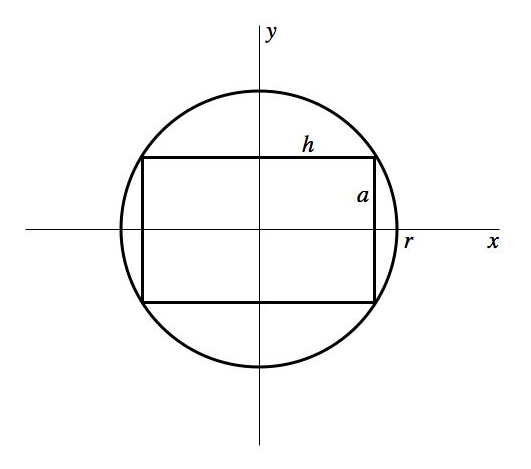
If you know the standard formulas for the volume of a sphere and the volume of a cylinder, all you need to do is use some elementary integral calculus to compute the volume of the circular cap that falls off each end of the sphere when the cylinder is drilled out, and then you can calculate:
Vol of ring = vol of sphere – vol of cylinder – 2 x vol of end cap.
The entire computation is given here.
In the extreme case where the cylinder has height r, the radius of the sphere, the cylinder has zero diameter, of course, so no volume is removed from the sphere, and in this case the volume formula reduces to 4/3 pi r3, the standard formula for the volume of a sphere.
As the only mathematician present, I was asked to explain how this answer is obtained. We were, however, in a restaurant at dinner, and with the main course about to be served, I was reluctant to start scribbling on napkins (for which rings were not provided, as it happens). Instead, I remarked that this was a well-known problem in calculus courses, and that they would have no trouble finding the answer on the Web. Search on “napkin ring problem” or else the search terms “volume + sphere + cylinder + removed” I said.
That was the end of the discussion, but afterwards I went online to see what kind of answer my dinner colleagues would find. A search along the above lines does yield a number of hits. I was relieved to find that most of them are correct, though in many cases non-mathematicians might find the explanations hard to follow. But there were some glaringly false answers. In particular, the solution posted at WikiAnswers is
4/3 pi r3 – 2 pi r2h
This answer has two terrible errors: first, assuming the cylinder has the same radius as the sphere and second, forgetting to account for the two end caps. My experience emphasized yet again that anyone who uses the Web to find information should exercise caution. Just because something it stated in a professional looking web page, doesn’t mean it is necessarily correct. Students please take note.
Lockhart’s Lament
Finally, in last month’s column I reproduced in its entirety an essay on K-12 mathematics education by a New York based math teacher (with a Ph.D.) called Paul Lockhart. The publication of Lockhart’s essay generated a large volume of email for me, and apparently a much larger flood for Paul himself. The emails I received ranged from the passionately negative (one writer started his tirade with the words “the guy borders on being a complete whack-job”) to the highly enthusiastic. The latter were by far the majority. There were also a number of emails that, while generally in support of the points Lockhart was making, sought to temper or counter particular aspects of his argument, for various reasons. Many of the points raised were related to the fact that, in addition to mathematics’ intrinsic beauty as an intellectual pursuit, it is a darned useful tool that many professionals need to have mastery of, but have little interest in, or time to focus on, the subject itself. This connects to the “American Mathematics in a Flat World” issues I raised in my January and February columns. I’ll provide a summary of the feedback I received in a later column.
Devlin’s Angle is updated at the beginning of each month.
Mathematician Keith Devlin (email: devlin@csli.stanford.edu) is the Executive Director of the Center for the Study of Language and Information at Stanford University and The Math Guy on NPR’s Weekend Edition. Devlin’s most recent book, Solving Crimes with Mathematics: THE NUMBERS BEHIND NUMB3RS, is the companion book to the hit television crime series NUMB3RS, and is co-written with Professor Gary Lorden of Caltech, the lead mathematics adviser on the series. It was published in September by Plume.
MAY 2008
Lockhart’s Lament – The Sequel
In last month’s column I discussed a classic calculus problem often referred to as the “napkin ring problem.” Although it appears at first glance like any one of dozens of volumes or revolution problems that calculus instructors give their students to practice their mastery of integration, this particular problem has a surprising answer. The volume of the napkin ring does not depend on the radius of the sphere from which a cylinder is removed to create the ring, but only on the height of the cylinder.
The proof I gave at the time was (deliberately) the “by the book”, pedestrian one. There is nothing difficult about it, and it does provide a perfectly good exercise in integration. Any student who can carry out the calculation I gave has demonstrated mastery of the technique for calculating a volume of revolution. No ingenuity is required. It’s a routine application of integration. The question is, what is the student’s response on seeing that surprising answer? Mathematics teacher Paul Lockhart would surely hope—wish—that the student would be prompted to ask “Why?” and would then seek to find an explanation. (Yes, last month’s column was a set-up. I must have watched too many episodes of Prison Break.)
We met Lockhart in my March column, which was devoted to publication, for the first time, of an essay Lockhart had written back in 2002. In that essay, he argued for teaching that awakened and stimulated students’ natural curiosity. We’ll come to that argument momentarily. For the moment, let me see if we can do as Lockhart would hope and figure out just what is going on with the napkin ring.
Once you have solved the problem the pedestrian way and found the formula for the volume of the napkin ring, it doesn’t take most mathematically able individuals long to come up with another derivation. What is more, provided you know the formula for the volume of a sphere, that alternative derivation makes no use of calculus at all!
If you have not come across the napkin ring problem before, you might like to try to solve it for yourself without using calculus. Otherwise, you will find the (non-calculus) solution here.
Reflections on Lockhart
Now back to Lockhart. As I had suspected (and hoped), the appearance of Paul’s essay generated a massive response, some of it coming to me, the bulk going directly to Paul himself. The remainder of this month’s column is devoted to a summary of some of the emails we received, with some editorial comment from me and a lengthy response by Paul.
By far the greater portion of the emails I received, and I gather almost all the ones Paul received, were largely congratulatory or else highly favorable to the essay. My editorial focus here is, however, on the responses that took issue with one or more of the points he made. For the writers made what I believe to be valid criticisms.
[BTW, it never ceases to astonish me that some readers assume the job of an editor or a columnist is to write or give voice only to articles or opinions that he or she agrees totally with. When I published Paul’s essay, I wrote: “It is, quite frankly, one of the best critiques of current K-12 mathematics education I have ever seen.” That doesn’t mean I agree with everything in the essay, for heaven’s sake! In fact, it doesn’t imply that I agree with anything he said, though as it happens I agree with many of his points. Lockhart wrote eloquently and with passion about an issue he is intimately familiar with, raising many important points. And as someone whose career has included both high level mathematical research and K-12 mathematics teaching, he brings a perspective that relatively few MAA members can claim. That’s why I wanted to bring his essay to a wider audience.]
One question raised in my mind on reading Paul’s essay was, what can we learn in terms of our mathematics education system? Leaving aside for a moment the pluses and minuses of the kind of approach he advocates, is it reasonable to expect that we could provide all school pupils with a similar experience? I fear we all know the answer to that one. Heavens, pupils in the K-12 system are lucky if they are taught mathematics by someone who has taken more than one or two college courses in math, let alone majored in the subject. And to teach Paul’s way requires (I believe) far more than having a bachelors degree in mathematics. It requires someone very much like himself, someone who loves mathematics and has mastered it to a professional level. (A successful research career, as Paul has under his belt, is probably overkill, though I am sure it helps in a number of ways.)
Though I would love to see every school student exposed to real mathematical thinking and stimulated the way Paul advocates, I think it is simply not feasible. (Not that Paul claims it is; as he points out in his response below, his essay is a lament, not a proposal.) It is, I suggest, inescapable that at the systemic level, we cannot avoid having to provide classroom teachers with a fairly well-specified prescription to follow, and we must accept that many of them will be unable to deviate much, if at all, from that prescription. This does not mean there is nothing to learn from Paul’s experience in terms of curriculum specification. A fairly thorough prescription should not shackle teachers. It would be a tragedy if the system prevented talented instructors from providing their pupils with the kind of stimulating experiences Paul describes. A Mathematician’s Lament may not be a proposal, but we can surely learn a lot from what Lockhart says.
Another reaction I had to the essay was that Paul’s approach is geared to developing in his pupils a love for mathematics as an enjoyable and challenging intellectual pursuit. Now, there is no doubt that for many of us, mathematics is precisely that. Nothing wrong with trying to foster it in as many young minds as we can. But mathematics has another face. It is one of the most influential and successful cognitive technologies the world has ever seen. Tens of thousands of professionals the world over use mathematics every day, in science, engineering, business, commerce, and so on. They are good at it, but their main interest is in its use, not its internal workings. For them, mathematics is a tool. Even if they had an interest in investigating the inner workings of that tool (and there are plenty who claim they do not), they do not have the time; the problems they are trying to solve are simply too pressing and too demanding. Having solved the napkin ring problem the routine, pedestrian way, by integration, for them the issue is over—the problem is solved—and it’s time to move on. This is the utilitarian face of mathematics I talked about in my January and February columns, in connection with national competitiveness in the global economy. I fear that Paul’s approach would not serve those individuals particularly well. Exposure for an initial few years, perhaps yes, and maybe a term or two thereafter. But as a nation I don’t think we can afford to take it as the norm. Industry needs few employees who understand what a derivative or an integral are, but it needs many people who can solve a differential equation.
As you will see, Paul himself counters this by drawing a distinction between K-12 education and college level. Personally, I’m not convinced that it will work to leave the “training for a competitive economy” stuff to college level, but it sure would be nice—and I believe would help us remain a competitive economy—if students were exposed to the kind of experience Paul advocates throughout their mathematics education, if such were possible.
I had other thoughts too, as I read, and then re-read Paul’s lament. But most of them were also addressed by the emails I received, so I’ll let those respondents speak for themselves. Then I’ll let Paul respond.
What you said about Lockhart’s lament
One reader (with a Ph.D. in mathematics) sent me an email that seemed to encompass much of my own thinking:
“I was very impressed with “Lockhart’s Lament” that you recently posted on Devlin’s Angle. Lockhart presents one of the most uncompromising versions I have encountered of the hedonistic approach to mathematics education: unless learning mathematics is fun it’s no damn good. This is a position for which I have a lot of sympathy. As a kid I was drawn to mathematics precisely by its fun aspects, emphatically not by its utility. But while the hedonistic approach is probably feasible at the level of the classroom, and perhaps even the school, the difficulty comes when we try to scale up to the level of a “system,” such as a county, state, or nation. For educational systems almost inevitably entail measuring results, an activity from which Lockhart clearly recoils. “There should be no standards, and no curriculum. Just individuals doing what they think best for their students.” (p. 23) Furthermore, mathematics is in fact useful, and Lockhart surely goes overboard in relegating this utility to such a secondary position. I infer that he thinks the useful aspects of mathematics can be picked up as needed at any time, by anyone imbued with the true spirit of mathematics. Perhaps, but does not the hedonistic approach, taken to its extreme, risk producing students only willing to tackle problems that please their aesthetic sense? And it is alas true that mathematics can be usefully applied by many who possess little or no appreciation for its beauty. This being so, why should society expend resources to impart knowledge of this beauty? One might argue that aesthetic appreciation of mathematics in some way makes a person better at applying mathematics in even the most mundane setting. I’m not sure this is true, and have no idea how one could ever compile evidence to support it. It would pose a special challenge to Lockhart, with his aversion to measuring educational results. He is reduced to something like, “Trust me, this is the best way to teach math for all purposes.”
Such are the pragmatic objections to Lockhart that occur to me. Of course Lockhart is no pragmatist, proudly so. But as a goad to rethinking the most basic issues of math education, as a bomb for exploding conventional notions, his essay is valuable indeed.”
Another reader wrote to me:
“Paul Lockhart is right that there is much that could be done to improve mathematics education. He is right that the current curriculum contains too much material and is too heavy on facts and skills that are easy to test. But his idea that mathematics is a pure art form that should be appreciated and taught as such is wrong. His ideas about art are equally wrong. The idea of art as free expression is romantic folly. Artists are problem-solvers. They are working for a living. They produce, play music, and dance for others for money. My artist friends, the successful ones, are taken up much of the time considering how to perfect or extend their craft and how to sell more product.
I studied graphic arts and designed books, fliers and posters. While I was taking a design course [my instructor] passed by me as I was laboring over a design project for him. “Have you solved it yet?” he asked. That was when I realized that the essence of art was applied problem-solving… [Let me point out how] completely erroneous [many popular] ideas about success in the arts are: as if one somehow either was born with the ability to play the violin or not. Talent plays a role, but time-on-task is the great determiner of achievement in playing an instrument and in doing mathematics. These arts are mastered at the cost of sweat, and their practice is not easy.
If the point is that more time should be available to develop mathematical ideas in class and that teachers should be under less pressure to cover techniques and should have more time to explore ideas with students, then I am already with you. But the sort of arguments that Paul Lockhart has in this piece do not advance that cause. Moreover, since they consign everyone (educators, the public, teachers, and publishers) to perdition, this seems to leave Paul Lockhart alone to do the good thing. This will not work.”
Another reader (a university professor) took Paul to task for ignoring the history behind the current mathematics curriculum:
“As I see it, Paul Lockhart’s essay would be much more powerful if it were not written in such a complete historical vacuum. Although Lockhart decries the sterile formalism in which mathematics courses have been and continue to be taught, he makes absolutely no reference to the fact that the traditional mathematics curriculum was demolished by the excessive formalism and abstractions of the SMSG new math, as incorporated in the Houghton Mifflin series of books co-authored by Mary P. Dolciani. This apparent ignorance on Lockhart’s part is likely due to the fact that he was educated with Dolciani-type books, and he may not be aware of the preceding textbooks.”
Finally, another e-mailer (also a university professor) quoted the following passage from Lockhart’s lament:
“All metaphor aside, geometry class is by far the most mentally and emotionally destructive component of the entire K-12 mathematics curriculum. Other math courses may hide the beautiful bird, or put it in a cage, but in geometry class it is openly and cruelly tortured. (Apparently I am incapable of putting all metaphor aside.)“
The e-mailer then went on to write:
“I am not alone among Ph.D.’s in mathematics for whom traditional proof-based Euclidean geometry, T-proof even with its idiocies, was the first real introduction to a lifetime of mathematics. And communication of geometry, proof-based geometry, remains among my favorite topics although none of my professional work is in geometry. The subject is beautiful and the logic, semi-formal deductive reasoning, remains the same – and hugely important to human thought – over millennia. The fact that it has been eliminated – or distorted beyond reason – from the precollegiate preparation of many strong college-bound students borders on sinful.”
Although this passage was part of a message that was extremely critical of Lockhart’s essay, I’m not entirely sure that on this point the two are fundamentally at odds in principle, though I’m definitely with Lockhart in being opposed to “formal proof” as so often practiced in school classrooms, whereas I gather the email writer sees benefit (presumably a net benefit) in what are sometimes called cookie-cutter proofs.
Lockhart responds
First off, let me take this opportunity to thank Keith for offering to publish my essay, and to thank all of you who have written in with your comments and questions. The response has been absolutely wonderful.
I would like to begin by reminding readers that what I have written is a Lament, not a Proposal. I am not advocating any particular plan of action; I am merely describing the extremely sad and painful (and probably hopeless) state of affairs as I see it: mathematicians are not interested in teaching children, and teachers are not interested in doing mathematics.
If I am advocating anything, it is only the obvious (and time-tested) idea of “learning by doing.” If I have a method, it is only to convey my love for my subject honestly, and to help inspire my students to engage in a delightful and fascinating adventure—to actually do mathematics, and to thereby gain an appreciation for the depth, subtlety, and yes, utility, of this quintessentially human activity. Is that really such a strange and radical idea? Have we really reached a point where one has to argue for teaching that “awakens and stimulates students’ natural curiosity?” As opposed to what? I thought that was the definition of teaching!
I find it a bit frustrating that I am put in the position of having to defend such a simple and natural idea as having students engage in the actual practice of mathematics. Shouldn’t it rather be the proponents of the current regime who should have to defend their bizarre system, and explain why they have chosen to eliminate from the classroom the actual ideas of the subject? You say I take a hedonistic approach to mathematics education? I call it a mathematical approach to mathematics education!
What I find so pathetic about our math education system is that it reduces a lively, creative, and messy human art form to a sterile set of notations and procedures, then attempts to train students to master them and become “technically skilled.” Of course it fails even on its own terms because there is no coherent narrative—the teacher doesn’t know where the natural logarithm came from, what its problem history is, what it means within the context of modern mathematics, only that it’s on the test and the students need to “know” it. So the students cram some formulas into their heads for a day or two, pass a test, and promptly forget them. Of course most people can’t retain dry, meaningless hieroglyphic information that they had no role in creating or contextualizing, so they get classified by the teacher (and by themselves) as “bad at math.” (I worry that the most talented mathematician of our time may be a waitress in Tulsa, Oklahoma who considers herself bad at math.)
What are the goals of K-12 mathematics education?
One theme that seems to recur in discussions of my essay is this idea of training the 21st century workforce to be responsive to the needs of industry and to be “competitive in the global economy.” I am no economist, but this seems to be more a matter concerning college and graduate level education, not the K-12 setting with which my essay is nominally concerned. Of course (as you may easily imagine) I have quite a bit to say about the disastrous state of affairs at the university level, but perhaps this deserves a separate discussion. (I have, however, received numerous emails from graduate students and researchers in mathematics and the physical sciences who feel that my essay hit the nail on the head for them as well.) So let’s save the economic discussion for another time.
So the question is, what should be the goals of K-12 mathematics education? Or, to put it in somewhat more inflammatory terms, what whole categories of human experience do you want hidden from your child? Any other “enjoyable and challenging intellectual pursuits” you wish to prevent your youngster from engaging in? Painting and music certainly don’t seem very practical, and neither does all this literature and poetry. Why should society expend resources to impart knowledge of any form of beauty? My god, there’s so much unprofitable, non-industrial fluff our young economic units are being wastefully exposed to!
But seriously, are we really saying that introducing children to mathematics and helping them to develop a mathematical aesthetic is a bad thing? Inspiration, wonder and excitement can only lead to positive results. And it is especially valuable to have this kind of energy and enthusiasm when learning to master a new technical skill. Practicing a new scale is a lot easier when it occurs as part of an interesting, challenging, and beautiful piece of music.
Look. A child will have only one real teacher in her life: herself! I see my role as not to train, but to inspire and to expose my students to a wide range of ideas and possibilities; to open up new windows. It is up to each of us to be students—to have zeal and interest, to practice, and to set and reach our own personal artistic and scientific goals. Children already know how to learn: you play around and have fun and struggle and figure it out for yourself. Grownups don’t need to hold infants up and move their legs for them to teach them to walk; kids walk when there is something interesting in the room that they want to get to. So a good teacher is someone who “puts interesting things in the room,” so to speak.
No? Alright, fine. I propose a curriculum for reading which has students first learn all the words that begin with the letter ‘A’ and then proceeds through the alphabet. The course of study would be divided into 26 Units, and naturally one could not ‘skip’ to the advanced ‘Q’ class without having taken the ‘P’ prerequisite. (Reading actual books would come much, much later of course.) I wonder why we don’t currently do this? Could it be because parents and teachers actually do read from time to time, so they know what matters and what does not? But the only source of information about what mathematics actually is comes from school itself: the 37th-generation photocopy of the same blinkered misconceptions, the perpetual feedback loop of School Math.
Suppose the devil were to offer you this deal: your child will get a perfect score on the English section of the SAT, but will never again read a book for pleasure. I would like to believe that no parent would make that deal. But how many would gladly shake the devil’s other hand? Math is not something we want our children to enjoy, it is something we want them to get through.
Pure math or applied?
Another thing that strikes me is how often I am placed on the wrong side of some sort of Pure vs. Applied, or Art vs. Technology debate. I have always found these to be false dichotomies. Mathematics is an incredibly rich and diverse subject. Can’t we enjoy it in all of its many shades and textures? Besides, what could possibly be more useful than a lifetime of free entertainment?
As Salviati says, just because I object to a pendulum being too far on one side doesn’t mean I want it to be all the way on the other side. I seek a balance. Can we not have Theory and Practice, Beauty and Utility? I may be a so-called “pure” mathematician, but that doesn’t prevent me from enjoying electronics and carpentry (and oil painting too, by the way). And yes, artists are problem-solvers. And problem solving is an art! By the way, many people (such as myself) enjoy drawing and painting and playing music for fun; not all artists are in it for the money.
The Pure/Applied distinction is one that I loathe. It is the creative/mindless distinction that I care about. Whether you are proving an abstract theorem about group schemes or calculating an approximate solution to a differential equation, you are either being a creative human being pursuing your curiosity or you are mindlessly following a recipe you neither understand nor care about. That’s the issue for me. And if all you are interested in is having a rote mechanical algorithm performed quickly and accurately, isn’t that what we build machines for?
My point is that at present we have neither Romance nor Practicality—nothing but a jumbled, distorted mishmash of pseudo-mathematical vocabulary, symbols, and mindless procedures. It is as if some extraterrestrial Captain Cook accidentally left behind a protractor and a logarithm table, and School Math is the “cargo cult” the natives have reconstructed. The current utilitarian regime is a complete failure. Not only do students have no idea of what the subject is actually about, they can’t even remember any of this supposedly “useful” information from one week to the next. That’s what happens when you remove the coherent narrative; and of course that’s what happens when you remove the students from the creative process.
Finally, in response to my mathematician friend, of course I have no objection to formalism per se. In fact, quite the contrary. The advent of formalism in mathematics is a crucial (and beautiful!) development. But there is a huge difference between a group of professional mathematician-philosophers (e.g. Euclid, Weierstrass) attempting to formalize and axiomatize the current state of their subject, and a roomful of fourteen-year-olds thinking seriously about shapes for the first time in their lives. My complaint (about High School geometry) is that the formalism is being attempted too soon, and not by the students. And I make no mention of the reasons or history behind the current disaster because I frankly don’t care which committee of idiots did what when; I care about mathematics and children.
And I certainly do care about measuring educational results. But what is an “educational result?” The twinkling eyes of my students, together with their heartfelt and beautifully expressed mathematical arguments are all the results I need.
Thank you, Paul!
to be continued … not necessarily in Devlin’s Angle, but throughout our profession, I hope. Thanks to the many of you who wrote to one or both of us. KD.
Devlin’s Angle is updated at the beginning of each month.
Mathematician Keith Devlin (email: devlin@csli.stanford.edu) is the Executive Director of the Center for the Study of Language and Information at Stanford University and The Math Guy on NPR’s Weekend Edition. Devlin’s most recent book, Solving Crimes with Mathematics: THE NUMBERS BEHIND NUMB3RS, is the companion book to the hit television crime series NUMB3RS, and is co-written with Professor Gary Lorden of Caltech, the lead mathematics adviser on the series. It was published in September by Plume.
JUNE 2008
It ain’t no repeated addition
In my column for September 2007, which was titled “What is conceptual understanding?” I remarked that I wished schoolteachers would stop telling pupils that multiplication is repeated addition. It was little more than a throwaway line, albeit one that I feel strongly about. I put it in to provide a further illustration for the overall theme of the column, to indicate that there are examples beyond the ones I had focused on. In the intervening months, however, I’ve received a number of emails from teachers asking for elaboration. Their puzzlement, they make clear, stems from their understanding that multiplication actually is repeated addition.
If ever there were needed a strong argument that professional mathematicians need to interest themselves in K-12 mathematics education and get involved, this example alone should provide it. The teachers who contact me do so because they genuinely want to know what I mean, having been themselves taught, presumably either in schools of education or else from school textbooks, that multiplication is repeated addition.
Let’s start with the underlying fact. Multiplication simply is not repeated addition, and telling young pupils it is inevitably leads to problems when they subsequently learn that it is not. Multiplication of natural numbers certainly gives the same result as repeated addition, but that does not make it the same. Riding my bicycle gets me to my office in about the same time as taking my car, but the two processes are very different. Telling students falsehoods on the assumption that they can be corrected later is rarely a good idea. And telling them that multiplication is repeated addition definitely requires undoing later.
How much later? As soon as the child progresses from whole-number multiplication to multiplication by fractions (or arbitrary real numbers). At that point, you have to tell a different story.
“Oh, so multiplication of fractions is a DIFFERENT kind of multiplication, is it?” a bright kid will say, wondering how many more times you are going to switch the rules. No wonder so many people end up thinking mathematics is just a bunch of arbitrary, illogical rules that cannot be figured out but simply have to be learned – only for them to have the rug pulled from under them when the rule they just learned is replaced by some other (seemingly) arbitrary, illogical rule.
Pretending there is just one basic operation on numbers (be they whole numbers fractions, or whatever) will surely lead to pupils assuming that numbers are simply an additive system and nothing more. Why not do it right from the start?
Why not say that there are (at least) two basic things you can do to numbers: you can add them and you can multiply them. (I am discounting subtraction and division here, since they are simply the inverses to addition and multiplication, and thus not “basic” operations. This does not mean that teaching them is not difficult; it is.) Adding and multiplying are just things you do to numbers – they come with the package. We include them because there are lots of useful things we can do when we can add and multiply numbers. For example, adding numbers tells you how many things (or parts of things) you have when you combine collections. Multiplication is useful if you want to know the result of scaling some quantity.
You don’t have to use these applications, but both are simple and familiar, and to my mind they are about as good as it gets in terms of appropriateness. (I do think that you need to present simply everyday examples of applications. Teaching a class of elementary school students about axiomatic integral domains is probably not a good idea! This column not a rant in favor of the “New Math”, a term that I use here to denote the popular conception of the log-ago aborted education reform that bears that name.)
Once you have established that there are two distinct (I don’t say unconnected) useful operations on numbers, then it is surely self-evident that repeated addition is not multiplication, it is just addition – repeated!
But now, you have set the stage for that wonderful moment when you can tell kids, or even better maybe they can discover for themselves, this wonderful trick that multiplication gives you a super quick way to calculate a repeated addition sum. Why deprive the kids of that wonderful piece of magic?
[Of course, any magic trick loses a lot once you see behind the scenes. In the very early days of the development of the number concept, around 10,000 years ago, there were only whole numbers, and it may be that the earliest precursor of what is now multiplication was indeed repeated addition. But that was all 10,000 years ago, and things have changed a lot since then. We don’t try to understand how the iPod works in terms of the abacus, and we should not base our education system on what people knew and did in 8,000 B.C.]
Mathematics is chock full of examples where something that is about A turns out to be useful to do B.
Exponentiation turns out to provide a quick way to do repeated multiplication—wow, it’s happened again! Is this math thing cool or what!
Anti-differentiation turns out to be a quick way to calculate an integral. Boy, is that deep!
I can just hear some pupils wondering, “Hey, how many more examples there are like this? This is really, really intriguing. It all seems to fit together. Something deep must be going on here. I’ve gotta find out more.”
I assume the reason for the present state of affairs is that teachers (which really means their instructors or the writers of the textbooks those teachers have to use) feel that children will be unable to cope with the fact that there are two basic operations you can perform on numbers. And so they tell them that there is really only one, and the other is just a variant of it. But do we really believe that two operations is harder to come to terms with than one? The huge leap to abstraction comes in the idea of abstract numbers that you can do things with. Once you have crossed that truly awesome cognitive chasm, it makes little difference whether you can do one abstract thing with numbers or a dozen or more.
Of course, there are not just two basic operations you can do on numbers. I mentioned a third basic operation a moment ago: exponentiation. University professors of mathematics struggle valiantly to rid students of the false belief that exponentiation is “repeated multiplication.” Hey, if you can confuse pupils once with a falsehood, why not pull the same stunt again? I’m teasing here. But with the best intentions of drawing attention to something that I think needs to be fixed.
And the way to fix it is to make sure that when we train future teachers, and when authors write, or states adopt, textbooks, we all do it right. We mathematicians bear the ultimate responsibility here. We are the world’s credentialed experts in mathematical structures, including the various numbers systems. (“Systems” here includes the operations that can be performed on them.) Our professional predecessors constructed those structures. They are part of our world view, things we mastered so long ago in our educational journey that they are second nature. For too long we have tacitly assumed that our knowledge and understanding of those systems is shared by others. But that isn’t the case. I have a file of puzzled emails from qualified teachers that testifies to the gap.
I should end by noting that I have not tried to prescribe how teachers should teach arithmetic. I am not a trained K-12 teacher, nor do I have any first-hand experience to draw on. But the term “mathematics teaching” comprises two words, and I do have expertise in the first. That is my focus here, and I defer to others who have the expertise in teaching. The best way forward, surely, is for the two groups of specialists, the mathematicians and the teachers, to dialog – regularly and often.
In the meantime, teachers, please stop telling your pupils that multiplication is repeated addition.
Devlin’s Angle is updated at the beginning of each month.
Mathematician Keith Devlin (email: devlin@csli.stanford.edu) is the Executive Director of the Center for the Study of Language and Information at Stanford University and The Math Guy on NPR’s Weekend Edition. Devlin’s most recent book, Solving Crimes with Mathematics: THE NUMBERS BEHIND NUMB3RS, is the companion book to the hit television crime series NUMB3RS, and is co-written with Professor Gary Lorden of Caltech, the lead mathematics adviser on the series. It was published last September by Plume.
JULY-AUGUST 2008
It’s still not repeated addition
Well, my previous column, “It ain’t no repeated addition”, certainly generated some interest, both in the form of emails directly to me and a thread on a popular teachers blogsite Let’s play math.
The thrust of my earlier column was a plea to mathematics teachers to stop telling students that multiplication is repeated addition. Doing that not only sets up the hapless student for later confusion when they encounter situations where that definition plainly makes no sense (negative numbers, fractions, irrational numbers), it also leaves them with a fundamental lack of understanding of basic arithmetic that those of us who teach at university level encounter with every year’s new intake.
I was delighted to see the blog thread. As I said in my original column, I know about mathematics and mathematics instruction at the college level, but have no experience teaching math at the K-12 levels. Thus, my only hope of influencing the way mathematics is taught—and does anyone doubt that our (US) public mathematics education system is in dire need of a major makeover—is to persuade or provoke (and then help, if I can) teachers to initiate a change. Seeing practicing teachers discuss my article was a true joy, though I have walked this earth long enough to know that one article and one discussion thread is unlikely to achieve much if anything on its own.
What worried me were some blog entries and a number of emails I received from teachers who said, in a nutshell, that I was making much ado about nothing. That it was okay to tell students something that is totally and utterly false, and then keep modifying it each time the students subsequently encountered a situation where what they were taught plainly does not work. If ever there were a case of passing the buck, that is it. Not only is that educationally unwise to keep changing the rules, I personally resent it because that buck eventually ends up in my college classroom, where I discover that I am expected to teach university-level mathematics to students who do not properly understand basic arithmetic, and have formed deep-rooted, but erroneous conceptions that get in the way of progressing in mathematics.
Of course, those correspondents were not consciously doing that. Indeed, it seemed clear from what they said that they themselves simply had not grasped the basics of arithmetic! In some cases I believe they honestly feel that multiplication really is, at heart, just a generalization of repeated addition.
Because I want to address a number of issues my correspondents brought up, this column will be a bit longer than usual, and some of the points I make will overlap with others. I did not contribute to the blog thread, nor do I respond here to posts to that blog, because I am not a professional K-12 teachers and have no experience in that, and thus have no business on their discussion blog. As I said last time, my expertise is captured by the first word in the term “mathematics teacher”. I am simply trying to raise awareness among teachers of some issues in contemporary mathematics that I suspect they may be unaware of (I may be wrong). How anything I say is factored into actual mathematics teaching practice is something outside my area of expertise. I strongly believe that the future lies in both groups, the mathematicians and the teachers, working together. (Not all my teacher correspondents agree with that approach, by the way, and some seem to resent an intrusion into what they regard as their domain and theirs alone. Ah well. I also know of many mathematicians who do not want to get involved in K-12 education either.)
The driving lesson
And so down to business. Taking the “it’s okay to introduce multiplication as repeated addition” argument and applying it to another domain, here is what its advocates are suggesting. Imagine your child wants to learn to drive a car. You pay for a course of lessons, and at the end of the first week you ask your child how it’s going.
“What do you mean you are learning how to hitch the horse to the wagon. I thought you were learning to drive?”
“Yes, we are. But the teacher says we should take account of the fact that horse-drawn carriages came before automobiles. The two forms of transportation have a lot in common, four wheels, a chassis, seats, and so on, but the earlier form is more basic since both the “engine” and the fuel are naturally occurring (horses and hay) and do not have to be designed and built by people. So my teacher thinks the best way to learn how to drive is to first master the more basic, earlier method, that people used for hundreds of years, and then we’ll be shown how to modify what we’ve learned to the case of automobiles. We’ll learn to understand cars and how to drive them by interpreting them in terms of horse-drawn carriages, which are more basic.”
Now, both forms of transport do fulfill the purpose of getting you from point A to point B in a sitting position, without having to provide the power yourself. And in some circumstances the two forms of transportation are in fact pretty well equivalent. Indeed, on some occasions, the horse-drawn carriage may do a better job. Nevertheless, by this stage in your discussion with your child I suspect you are likely to lose your cool. After all, for all the similarities, and despite the fact that one was a direct precursor of the other, cars and horse-drawn carriages are simply different forms of transportation, and your child will become a much better driver—and perhaps a good carriage driver as well—and achieve mastery much quicker, if each form of transport were taught in its own right, not one in terms of the other.
To be sure, a driving instructor might occasionally find it helpful to point out the similarities between cars and horse-drawn carriages, particularly in an age of diminishing fossil fuels. Seeing similarities (and differences) usually aids learning. But since they really are different forms of transport, used mostly for different purposes, most of us would think it better to approach them as completely different activities that just happen to have some similarities. Likewise for addition and multiplication. It might once have been okay to view multiplication as repeated addition (though I suspect not), but in today’s world, that is definitely not the case.
Arithmetic for today’s world
Let me be plain about it. Addition and multiplication are different operations on numbers. There are, to be sure, connections. One such is that multiplication does provide a quick way of finding the answer to a repeated addition sum. Indeed, if the only thing anyone ever needed to do with numbers is add them, either once or repeatedly, then there would be no need to have something called multiplication; there would simply be a clever shortcut to find the answer to a repeated addition.
But the world has a habit of presenting us with situations where addition simply is not enough. This happens in business, commerce, finance, science, engineering, all over the place. For instance, there is no way to understand a (continuous) volume control on a radio in terms of addition, either singly or repeated. A volume control is not an additive device, it’s multiplicative. Indeed, the entire domain of scaling (of which a volume control is just one simple example) is inherently multiplicative, just as combining collections is fundamentally additive.
Addition and multiplication aren’t enough for our world either, as it turns out. Biological growth and population growth are inherently exponential and cannot be understood as “repeated multiplication” (which would cash out as “repeated repeated addition” for those who advocate reducing all of arithmetic to addition).
Folks, we are living in the twenty-first century. Look around at the world our children are living in. If they do not understand addition, multiplication, and exponentiation, and are not deeply aware of the HUGE differences between those operations, there is no way they can lead informed lives and contribute adequately to society. A person who does not know the difference between multiplication and exponentiation is not going to appreciate why global warming is so very, very dangerous and will almost certainly affect us much sooner than any of our intuitions tell us.
Mathematicians sorted out the basics of arithmetic several centuries ago, and finished the job during the nineteenth century. It took a considerable effort, and changed the nature of mathematics considerably, setting the stage for the highly technological and scientific age we live in today. Just as Henry Ford perfected the family automobile, your civic-minded mathematicians figured out that today’s world (yesterday’s, actually) requires a number system that has three basic, but very different operations: addition (and its inverse subtraction), multiplication (and its inverse division), and exponentiation (with its inverse, logarithms), having certain, specified properties.
Now, if there were no way to teach arithmetic other than to follow the historical path, maybe there would be no alternative than to introduce multiplication as repeated addition and exponentiation as repeated multiplication, and then face the inevitable problems that come later as and when they arise. (Just as we do now, it appears!) After all, if you were faced with introducing the automobile to a remote tribe that had hitherto known only horse-drawn transportation, you might go the “horseless carriage” route. But children growing up in today’s world are surrounded by examples of collecting together, of scaling, and of biological or population growth, so there is surely no reason whatsoever why we don’t teach arithmetic correctly from the very start. Why introduce multiplication as repeated addition when we encounter scaling every day? Why introduce exponentiation as repeated multiplication when every day we see exponential growth in action?
Note that I am not saying we introduce addition as collecting together, multiplication as scaling, and exponentiation as growth. The mathematical operations are all abstract mathematical notions. My point is that those real world examples can be used to motivate and illustrate the basic operations of arithmetic. The real world examples all fail at some point or another – negative numbers for instance. (Incidentally, you avoid cognitive problems with negative numbers when you say from the start that number systems are things people invented to do things in the world—see later for more on this.)
If teaching arithmetic in the incremental manner some of my correspondents advocate (starting with addition of positive whole numbers and building up through multiplication as repeated addition and exponentiation as repeated multiplication) did not have any major downside, I would not be writing this particular column. But there is a downside. Remember that old adage, “first impressions count”? As most math teachers are probably aware, when you teach a new mathematical concept to someone, the way you first introduce it is almost certainly going to be the one the student retains. No matter how much you stress that the concept will later be changed in some way. Hence, every year, university professors are faced with students in their class who, deep down, believe multiplication is repeated addition and exponentiation is repeated multiplication. So powerful and long lasting is this first-model phenomenon, that several of the math teachers who emailed me clearly harbored that view! It’s a view of basic arithmetical operations that causes immense problems when students start to learn calculus.
So what should be done? How about taking a look at how mathematics is actually developed and used in the world.
Core mathematics—arithmetic in particular—is not developed in order to produce more complicated or more general variations of existing math. It is developed and expanded—with new operations introduced—to do new things in the world and to meet new needs in the way we live our lives. The world we live in—and even more so the world our children are living in and will live in—provides more than enough examples to motivate and explain the three basic operations of arithmetic. Why even try to motivate, justify and explain one arithmetic operation in terms of another (something that leads to later problems) when the world we live in provides all the motivation, justification, and explanatory power anyone could possibly need? No wonder children arrive at college not only having little or no genuine understanding of elementary arithmetic, they have long ago formed the view that math has nothing to do with the world they live in—that new math simply comes from old math, not from trying to do things in the world we live in.
The need for the concrete
Part of the problem, I suspect, is that many people feel a need to make things concrete. But mathematics is abstract. That is where it gets its strength. Multiplication simply IS NOT a generalized addition, and exponentiation IS NOT a generalized multiplication. Just as you can’t really say what the number 7 IS in concrete terms—it’s a pure abstraction—so too you can’t say what addition and multiplication and exponentiation ARE. They are BASIC, not derived. A significant part of mastering mathematics is coming to terms with that.
I personally find it odd that people feel comfortable with addition as a basic operation, not reducible to anything “more basic,” but not equally comfortable with multiplication or exponentiation as basic operations. After all the “putting together collections” application of addition only provides an interpretation in the case of positive whole numbers, and examples of putting together fractions of pies only gets you addition for positive fractions. What do you do to gain understanding when the numbers are negative or irrational?
The hard step is the one that takes you into the abstract realm of numbers in the first place. If a child has bought into addition (including negative numbers and irrationals), he or she has made the leap to accepting an arithmetic operation as basic and not reducible to anything “simpler”. Take advantage of that.
On the other hand, I sympathize with those people who emailed me or contributed to that blog thread I mentioned, who are clearly struggling to find answers to the “What is it?” question. It’s a natural question. Unfortunately, trying to find an answer holds back mastery of mathematics, which largely depends on getting beyond the concrete and into the realm of the abstract – on recognizing that the “What is it?” question is simply not appropriate for the basic objects and operations of mathematics. “It” is what “it” is. What is important is what “it” does.
Over a century ago, mathematicians finally learned to sidestep that unanswerable “What is it?” question by adopting the axiomatic approach, where you simply specify the properties of numbers and the arithmetical operations, and concentrate on manipulating them according to those rules. As the great mathematician David Hilbert put it so evocatively at the end of the nineteenth century, the objects of mathematics may as well be bar tables and beer mugs, and the operations on them equally bar-like, provided you specify the properties of those operations appropriately. (Hilbert was focusing on geometry at the time, but his remarks hold for any area of mathematics, and he advocated adopting that approach to all of mathematics.) Hlbert, by the way, was viewed as the best mathematician in the world at the turn of the twentieth century. Among the many things he did was find (and correct) many fundamental errors in Euclid’s axiomatic geometry, something that no one else had done in two thousand years of studying Euclid’s classic book Elements.
The system view
In the case of arithmetic, mathematicians since Hilbert have approached arithmetic as an activity that is done within a number system. The starting point—what you are given, as basic—comprises the numbers (be they whole numbers, rational numbers, real numbers, or whatever—and there are others) together with certain operations on them. (Usually these are addition and multiplication, but you could include exponentiation if you want.) This is what the word “system” means here. The basic properties of the system are specified by a set or rules, usually called axioms. The question of what the “numbers” are or what the “operations” are does not arise—that is to say, mathematicians learned long ago that it was fruitless to ask that question, and actually unnecessary to have an answer.
I should point out that this was not done as some irrelevant academic exercise. Rather, the rapidly changing world was throwing up new problems for which the old mathematics was (demonstrably) not adequate. True, the inadequacies never show up in the school curriculum, which focuses almost entirely on mathematics much of which was done two thousand years ago, and virtually nothing less than five hundred years ago. Thus many teachers (and my main focus is on the K-8 range) are totally unaware of the fundamental changes that took place in mathematics in the nineteenth and twentieth centuries. But some of their students will likely go on to pursue careers for which they very definitely need modern mathematics (the automobile rather than the horse-drawn carriage), and embedding false initial concepts in their minds does them a grave disservice.
One feature of the change in approach that Hilbert commented on (and advocated with great passion) is that it turned the historical development on its head. The familiar path from positive whole number arithmetic all the way to arithmetic on the real numbers (as used in calculus) that many teachers (for the most enticing of reasons!) find so attractive—which is actually not the same as the actual historical development, but never mind for now—goes completely counter to the way arithmetic systems should be developed to be able to meet today’s societal needs. Arithmetic (with exponentiation) on the real numbers system is the most fundamental. All other arithmetics are special cases of that. (Full disclosure: the complex number system is the one you need to start with to really do everything you need in the world. But in this column I’m focusing only on the number systems that typically arise in K-8 or perhaps K-12 mathematics. Complex numbers have no good intuitive conception other than a geometric one that is only partially effective, and so have to be developed axiomatically. But they come so late in the educational process, and the step is restricted to students who have already mastered a lot of other mathematics, that there really isn’t any need for a “conceptual prop”, nor is there any danger of something having to be undone later.)
One consequence of the 180 degree turnaround is that addition on the positive whole numbers is a special case of addition on the real numbers, and multiplication on the positive whole numbers is a special case of multiplication on the real numbers. And make no mistake about it, real number multiplication most definitely is not repeated real addition.
The point is, the needs of society made it necessary to produce a single number system that works for all possible purposes. The real number system (strictly, the complex number system) is that system. All other number systems are subsystems. Since the real number system is the one that connects to the real world in the most significant way, it is the one that must be taken as the default.
Of course, since this all happened just a hundred years ago, many, perhaps most school mathematics teachers are never exposed to it. (If so, it’s not their fault, the problem lies with the system that educated them.) As a result, it is not surprising that some of the teachers who contacted me and wrote on that blog really did not know what my point was. They did not know that a more-or-less historical-based approach, based on reducing successive operations to ones previously introduced, is no longer the way to go. (Actually, I don’t think anyone can say that for certain that a particular way to teach is not going to work. But for the reasons I indicated above, it is going to be tricky to pull off without harmful fallout for the students down the line. But now we are into the teachers’ domain of expertise, not mine.)
Interpreting the new and strange in terms of the old and familiar is a natural human way of coming to terms with change. For instance, when cars first came along, people did initially interpret them as a variant of what they were familiar with. Early cars were called “horseless carriages.” But once people were familiar with cars, and in particular once cars had established themselves as a primary means of personal transportation, cars were viewed entirely in their own right. They had to be in order for society to advance. It’s exactly the same with number systems.
What to do?
As I remarked in my last column, I am certainly not advocating we teach arithmetic to pupils in the K-8 grades using the axiomatic method in all its formal glory. This is pretty sophisticated stuff. But, since that is how mathematicians finally resolved the issue, it makes sense to take that as our guideline, if at all possible. Over a hundred years has passed since the development Hilbert referred to gained general acceptance among the mathematical community. In almost any other walk of life but mathematics education, that would be more than long enough for the message to filter through.
[Actually, the mathematics education people did try it once, but they bungled it. That was the disastrous “New Math” movement of the 1960s. As I said last time, I am definitely not suggesting a return to that debacle. But just because the execution was so poor does not mean there were not some good ideas floating around. A principal driving force was the recognition by universities that incoming students were not equipped to learn the kind of mathematics needed in today’s world. They still are not.]
By the way, adopting an axiomatic approach does not mean that the familiar numbers systems (whole numbers, rational numbers, and reals) are arbitrary inventions. You are certainly free to come up with your own system, and it may lead to some intriguing mathematics, but it is unlikely to draw much attention unless it turns out to be useful. The purpose of the process Hilbert was advocating was to make precise, and help people to understand, systems that are useful in the real world. Numbers are used for counting and measuring, in particular. The axioms mathematicians formulated for them were carefully chosen to capture all the properties of numbers that you need when you use numbers in the world – including the useful fact that when you do a repeated addition, you can get the answer by multiplication.
Yes, that useful fact is built in to the system; but as something that can be done, not as a defining principle. It is simply a property of those two operations addition and multiplication that is a consequence of the axioms, not a recipe for building multiplication from, or reducing it to, addition. Which is just as well, since in many real world instances, multiplication is not repeated addition (e.g. when you multiply any two negative numbers or multiply pi by the square root of 2).
In the absence of being able to provide a concrete answer to the “What are these?” questions, what mathematics teachers surely can do (and I would say definitely should do) is (1) use real world examples, such as collecting together, scaling, and growth, to motivate, introduce, and exemplify the basic operations of arithmetic; and (2) provide and demonstrate the use (both in a “pure” setting and with applications) of the rules needed in order to do arithmetic.
And why not let the students have the thrill of discovering for themselves (perhaps with a hint or two) that multiplication provides a quick way to get the answer to a repeated addition. Historically, multiplication may have first arisen out of addition. But as with the automobile and the horse-drawn carriage, things have moved on since then, and we’ve developed our numbers systems to meet the needs of today’s world. Yesterday’s foundational ideas have become just useful tricks today.
Let me stress again that I am not suggesting we teach children arithmetic the way professional mathematicians view it. Rather, my point is that, however you teach it (and I defer to professional teachers in figuring out the how), don’t do anything that is counter to the way the mathematicians do it. Remember we are in a mathematical age equivalent to the automobile, not the horse-drawn carriage. One reason to avoid running counter to the way mathematics is used in the real world is that some of your pupils may well end up in universities where they will HAVE to do it the right way (i.e., the way we have found works for all purposes in today’s world), so that they can go on to actually use it in the world. And that means the student has to realize that addition and multiplication, and exponentiation if you get to it, are different basic arithmetical operations, with no one reducible to either of the others. (Technically, exponentiation is not “arithmetic,” it’s what is called “analytic,” but that’s a distinction outside my present scope.)
If, as I strongly suspect and have suggested elsewhere, understanding mathematics can come only after mastery of technique, then that is simply a part of learning mathematics we have to live with. The “learn the technique first and understand later” approach is very definitely the only way to learn chess, and millions of children around the world manage that each year, so we know it is a viable approach. Why not accept that math has to be learned the same way? (At least for now, if you believe a better way will eventually be found.)
[There is actually some evidence that students learn faster and with a more robust outcome when it is learned abstractly, by the rules, but that’s another story and not a factor I’m basing my plea on here.]
The bottom line for me is that having students get to university without a proper understanding of arithmetic is simply not acceptable in a major developed country like ours. I see absolutely no reason not to do this right—or at least to avoid doing it wrong.
For the record
For the benefit of those readers who want to see the details, the axiom systems for the different number systems are: the axioms for complete ordered fields describe the real number system, the axioms for fields describe the rational number system, and the axioms for integral domains describe the whole numbers. You can find discussions of these systems in any contemporary college-level algebra textbook.
Starting with the reals, which are a complete ordered field, if you restrict to the rational numbers you get a field (which, though ordered, is not complete), and if you restrict further to the whole numbers you get an integral domain (which is not a field). The positive whole numbers do not really constitute a number system, and so mathematicians have had no reason to write down axioms to describe them as such. At the turn of the twentieth century, an Italian mathematician called Peano did formulate what are often called the Peano axioms, but their purpose is to show how the positive whole numbers can be defined from first-order logic; they are not a descriptive axiom system that tells you how to work in the system, as are the other axiom systems I just listed.
The point to bear in mind is that, once you have specified the real number system, everything else follows, whole number arithmetic, rational number arithmetic, and all the relationships between the different subsystems. In particular, there is just one kind of number, real numbers, one addition operation, one multiplication operation, and one exponentiation operator (where the exponent may itself be any real number). You get everything else by restricting to particular subsets of numbers. The axioms do not tell you what the real numbers are or what the addition and multiplication operations are; they simply describe their properties vis a vis arithmetic. The axioms for a complete ordered field describe the properties those operations have when applied to all real numbers, the axioms for a field describe the properties the operations have when restricted to the rational numbers, and the axioms for an integral domain tell you how the operations behave when you restrict them to whole numbers.
As I said earlier, I don’t think it would be a sensible thing to teach arithmetic by starting with the real number system; indeed, I find it hard to imagine how that could possibly succeed. But since that is the culmination of the arithmetic learning journey, it would be wise to avoid doing anything that runs counter to that final goal system.
Devlin’s Angle is updated at the beginning of each month.
Mathematician Keith Devlin (email: devlin@csli.stanford.edu) is the Executive Director of the Center for the Study of Language and Information at Stanford University and The Math Guy on NPR’s Weekend Edition. Devlin’s most recent book, Solving Crimes with Mathematics: THE NUMBERS BEHIND NUMB3RS, is the companion book to the hit television crime series NUMB3RS, and is co-written with Professor Gary Lorden of Caltech, the lead mathematics adviser on the series. It was published last September by Plume.
SEPTEMBER 2008
Multiplication and those pesky British spellings
In my previous two columns,”It Ain’t No Repeated Addition” and “It’s Still Not Repeated Addition”, I explained why I (and many others who are far more knowledgeable about K-8 mathematics education than I) think it is bad to teach multiplication as repeated addition.
To a casual observer, I imagine that the minor firestorm in various math blogs that my columns generated might suggest that my remarks injected something new to the mathematics education field. But, in fact, everything I said has been written about and discussed in the mathematics education community for some forty years or so, and essentially (though not in every detail) agreed upon. Discussed and agreed upon by people who have spent their professional careers studying those issues and have formed carefully thought out conclusions that have been subjected to, and passed, professional peer review.
This month’s column presents some of the data on which I based by original postings. That, of course, makes the column much longer than usual. On the other hand, I’ll be quoting from some of the leading mathematics education scholars of the twentieth and twenty-first centuries, so I hope you think it’s worth it.
K-8 mathematics education is perhaps more complicated than other subjects because there are two major domains involved: mathematics and mathematics education. My area of expertise is the former. For much of my career, I knew little of the latter, and was, quite frankly, somewhat dismissive of it. Then, as a result of various career moves, I found myself interacting more and more with members of the math ed community, culminating in my appointment to the Mathematical Sciences Education Board a few years ago. And that experience opened my eyes to just how ignorant I was of the problems inherent in mathematics education, and how we professional mathematicians, while clearly having something important to contribute to mathematics education, are manifestly unable to do it alone. Mathematical cognition is simply too complicated a subject to handle properly without multiple sources of expertise. (As is usually the case, perhaps the most valuable outcome of learning, definitely true in my case, is a better appreciation of the limits of what we know, and where our ignorance begins. I think Richard Feynman once said something along those lines. If he didn’t, he should have.)
Piaget said it first
The complexities inherent in learning multiplication, and the importance of noting the distinction between multiplication and addition, were first pointed out (to the best of my knowledge) in Piaget’s groundbreaking work in the 1960s and 70s. (See, for example, Jean Piaget, The Child’s Conception of Number, Norton, 1965, or Piaget, Grize, Szeminska and Bangh, Epistomology and the Psychology of Functions, Reidel, 1977.) Piaget presented evidence-based arguments to show that multiplication is fundamentally different from addition, and should be taught as such. In various writings, he suggested ways multiplication could be taught, and presented evidence to show that children as young as six were able to grasp some of the basic ideas that underlie multiplication.
More recently, mathematics education experts Terezina Nunes (London University) and Peter Bryant (Oxford University) devote two entire chapters (Chapters 7 and 8) of their excellent 1996 book Children Doing Mathematics to the distinction between multiplication and repeated addition, explaining in some detail the many subtle problems inherent in mastering multiplication.
Arguably Nunes and Bryant know more about multiplication and how to teach it than any other researchers in the world, though it would appear that language translation difficulties prevent their work from reaching many US-based bloggers. (The Brits, of course, spell “maths” with a plural “s” and often use an “s” where we know it should be a “z”.)
The language translation problem clearly causes further problems for many US-based commentators, since, in addition to the excellent and exhaustive work of Nunes and Bryant, a lot of the other research into the nature of multiplication, how people perceive it, and how best to teach it, has also been carried out in the United Kingdom. (Perhaps this is because British education researchers are unhampered by the Math Wars that continue to rage in the US, or by the often unhealthy influence of large textbook publishers we work under, or by the influence of lay local education boards that so often plagues US teachers.)
A further impediment to acquainting oneself with the research that has been done into the teaching and learning of multiplication—and the consequences of doing it wrongly—seems to be the difficulty of typing the term “repeated addition” into a well known search engine, which in a recent brief experiment I conducted brought up most of the references I cite below—generally on the first page of returns.
Okay, I’m teasing. Teasing and provoking are part of the stock-in-trade of columnists who think an issue is sufficiently important to be given an airing. And I do think the “multiplication is not repeated addition” issue really is important. (Moreover, the scope of the problem is widespread. According to some studies I’ll cite later, the belief that the two are the same is close to universal.) That’s why I am breaking the columnist’s rule of never going back to the same theme more than once. But, hey, the same rule holds for movies, and the new Batman did really well this summer. ‘Tis the season.
Why do I think this particular issue is important? Why do I insist we should avoid teaching young children that multiplication is repeated addition? Well, one very good reason is that it is just plain wrong. That ought to be enough of a reason, particularly in mathematics, which is all about precision and correctness, but for many people—brought up to believe multiplication actually is repeated addition—that does not seem to be sufficient. So I’ll have to take a sledgehammer approach and bring in some of the wealth of evidence to support my claim. (Actually, I have a better reason. Some teachers and several homeschooling parents emailed me and asked for further information.)
At this point, newcomers to this little mini-drama should read my two previous columns on the matter. (Something few of the bloggers who “responded” actually did, since most of the comments I saw before I gave up looking at them were about things I neither claimed nor implied, and in many cases had stated the exact opposite to. Maybe I still inadvertently use British linguistic constructs that baffle some readers.) Everything that follows presumes you have read the two earlier episodes, and for the most part I won’t repeat here points I made there. Now read on …
The bloggers’ arguments
By and large, the bloggers’ arguments boiled down to six kinds:
1. We’ve always taught it that way so why should we change?
2. I learned it that way and it worked for me. (This claim was almost invariably followed by statements that indicated that the writer had actually come out of the learning process with some serious misconceptions, proving my point not theirs.)
3. Repeated addition might be wrong from a mathematician’s perspective, but it works just fine for positive whole numbers and most of us don’t need arithmetic beyond positive whole numbers.
4. It might be technically wrong, but we can correct it later, and what harm does it do in the long run?
5. There’s no other way to do it.
6. There really isn’t a problem. Teachers don’t teach multiplication as repeated addition; rather they already do what I am calling for, so I was attacking a straw man.
There were also contributions having little to do with my argument. For instance, a number of people (maybe the same person, since blog contributors seem to post by pseudonyms) confused the fact that multiplication on the natural numbers can be reduced to addition on the natural numbers with whether or not addition and multiplication are the same arithmetic operations. (They are not.) I mentioned the former reduction procedure in one of my original articles, but reducibility of one mathematical abstraction to another tells us little about the relationship between the cognitive operations of concern. It doesn’t even tell us they are the same formal mathematical operation. Reducibility—which is not the same as equality—is of interest to pure mathematicians and philosophers; connections and differences between the operations students learn, understand, and perform are what matters in K-8 math education. There was also confusion about the significance of the standard definition of equality for Dirichlet-style functions, another red herring in the present context.
Of the six argument types listed above, only the last three arguments merit a response. (Note that 5 and 6 are contradictory.) In fact, I gave responses to 4 and 5 in my original articles, so rather than repeat here what I wrote already, I’ll re-address them here (along with point 6) by letting the words of the math ed experts speak for me.
[By the way, I sympathize with those respondents who noted that, while I might have identified a genuine and serious problem, I had not given a specific prescription of what should be done to correct it. Indeed I did not, for the reason that I don’t presume to be an expert in how to teach mathematics at the K-8 level. My perspective is of someone who has to teach the students who find their way to university, and find that some of them do not understand the basic operations of arithmetic. Of course, I’ve read much of the work of the math ed experts, so I know the results they’ve obtained. But that hardly makes me an expert in that field. This is a column in an e-zine of a professional mathematical society, with an editor and an advisory board, and I can be fired at any moment, as would surely happen were I to pretend to be something I am not.]
Multiplication is a tricky concept
Here is what Nunes and Bryant have to say about multiplication at the start of Chapter 7 of the book I cited above. (There are more British spellings in their work, so the bloggers won’t be able to read this valuable resource, though doing some research before launching into an Internet tirade is clearly not their forte.) The previous chapter deals with addition and subtraction.
According to [a common view] there need be no major change in children’s reasoning [after they have mastered addition and subtraction] in order for them to learn how and when to carry out multiplication and division. This view was challenged by Piaget and his colleagues […] who suggested that understanding multiplication and division represents a significant qualitative change in children’s thinking.
There certainly are significant discontinuities between addition and subtraction on the one hand and multiplication and division on the other… but there are some significant continuities too… the continuities and discontinuities are as important as each other, and both need to be thoroughly charted if we are to understand the many steps that every child has to take towards a full understanding of multiplication.
After acknowledging that there remains some controversy surrounding multiplication, particularly how you classify types of multiplication, the authors continue—and this is really important:
We must begin with a word of caution. Multiplicative reasoning is a complicated topic because it takes different forms and it deals with many different situations, and that means that the empirical research on this topic is complicated too. So, in order to make sense of the empirical work, we must first spend some time setting up a conceptual framework for the analysis of children’s reasoning and only then go on to review the research. […] Up to now it was possible to build the concepts and the vocabulary needed slowly through the chapter; with multiplication and division we stray so far from common sense and everyday vocabulary that we have to agree on a set of terms and conceptual distinctions at the outset.
It’s important to note that the particular difficulty Nunes and Bryant are alerting the reader to here is that required in understanding how children learn and do multiplication. The situation facing the child is a different one, namely learning what multiplication is, how to do it, and when and how to use it. But the task facing the researchers is tricky precisely because the concept is itself tricky.
[I suspect that most of us who end up being classified as “good at math” simply learn how to multiply, in a mechanical fashion, and only later come to understand what it is, if we reach such understanding at all. An interesting feature of those blog threads I mentioned is how they indicate that a fair number of people never reach the understanding stage.]
The authors’ above caution notwithstanding, I would strongly urge anyone teaching children to do arithmetic should read and reflect on (at least) Chapters 7 and 8 of the Nunes-Bryant book. Although not a “how to teach” book—it is a report of research findings—it does provide a wealth of ideas for how to do it. In particular, the authors indicate why teaching multiplication should involve exposing the students to three distinct kinds of problem situation: one-to-many correspondence situations (pp.143-146), situations involving co-variation between variables (pp.146-149), and situations that involve sharing and successive splits (pp.149-153).
Nunes and Bryant’s work alone, I think, takes care of question 5 above.
Incidentally, here is what Nunes and Bryant have to say about repeated addition (p.153):
The common-sense view that multiplication is nothing but repeated addition, and division is nothing but repeated subtraction, does not seem to be sustainable after a careful reflection about situations that involve multiplicative reasoning. There are certainly links between additive and multiplicative reasoning, and the actual calculation of multiplication and division sums can be done through repeated addition and subtraction. [DEVLIN NOTE: They are focusing on beginning math instruction, concentrating on arithmetic on small, positive whole numbers.] But several new concepts emerge in multiplicative reasoning, which are not needed in the understanding of additive situations.
They go on to enumerate and describe some of the more salient complexities of multiplication. The issue is far too complex for me to summarize effectively here. It takes Nunes and Bryant an entire chapter and then some. But note what they are saying in the above quoted passage: Even in the special case of the positive whole numbers, where repeated addition gives the answer to a multiplication sum, the two are not at all the same.
The problem with brittle metaphors
What about question 4? Why not start out by teaching children that multiplication is repeated addition, and then, when they meet cases where it is not (negative numbers, fractions, irrational numbers—hey, isn’t that actually most of the numbers?), simply get them to change their concept. Again, I provided a number of answers in my previous articles.
One is that the metaphor or model we first use to grasp a new concept is invariably the one that continues to dominate long after we have theoretically “learned” that it was not correct. Math ed specialist Ann Watson of Oxford University makes the same point in her article School mathematics as a special kind of mathematics (watch out for some more confusing British spellings) [http://www.math.auckland.ac.nz/mathwiki/images/4/41/WATSON.doc.]:
Additive to multiplicative reasoning: A shift from seeing additively to seeing multiplicatively is expected to take place during late primary or early secondary school. Not everyone makes this shift successfully, and multiplication seen as ‘repeated addition’ lingers as a dominant image for many students. This is unhelpful for learners who need to work with ratio, to express algebraic relationships, to understand polynomials, to recognise and use transformations and similarity, and in many other mathematical and other contexts.
Mike Askew and Margaret Brown, in their (British-English) paper How do we teach children to be numerate? [http://www.bera.ac.uk/publications/pdfs/520668_Num.pdf] make the same point (page 10):
… research has shown that multiplication as repeated addition and division as sharing appear to be widely understood by primary aged children. However, … understanding the meaning of multiplication is more complex (Nunes and Bryant, 1996) and difficulties with fully understanding multiplication and division persist into secondary school (Hart, 1981).
There is evidence that such early ideas—multiplication as repeated addition and division as sharing—have an enduring effect and can limit children’s later understandings of these operations. For example, understanding multiplication only as repeated addition may lead to misconceptions such as ‘multiplication makes bigger’ and ‘division makes smaller’ (Hart 1981, Greer 1988). Even with older children researchers have shown that they may persist with using primitive methods such as repeated addition or repeated subtraction with larger numbers (Anghileri, 1999).
For more of the same, but this time with American spelling, there is Thompson and Saldanha’s article Fractions and Multiplicative Reasoning, in Kilpatrick, Martin, and Schifter (Eds.), A Research Companion to Principles and Standards for School Mathematics, pp. 95-113, published by the National Council of Teachers of Mathematics, 2003. They say (page 103):
[…] multiplication is not the same as repeated addition. […] One may engage in repeated addition to evaluate the result of multiplying, but envisioning adding some amount repeatedly cannot support conceptualizations of multiplication. […] Generally, most students do not see proportionality in multiplication.
The authors go on to acknowledge (lament?) that a lot of instructors continue to perpetuate the problem:
In fact, a large amount of curriculum and instruction has the explicit aim that students understand multiplication as a process of adding the same number repeatedly. But an extensive research literature documents how “repeated addition” conceptions become limiting and problematic for students having them (de Corte, Verschaffel, & Van Coillie, 1988; Fischbein et al., 1985; Greer, 1988b; Harel, Behr, Post, & Lesh, 1994; Luke, 1988).
You can, of course, check out any of those cited sources for yourself. Note that this addresses point 6 in my above list, but I’ll come back to that later.
A controlled experiment
Want more? How about a controlled experiment? Jee-Hyun Park and Terezinha Nunes of Oxford Brookes University report in their paper The development of the concept of multiplication, published in the journal Cognitive Development, Volume 16, Issue 3, July-September 2001, pages 763-773 (watch out for more of those pesky British spellings):
Two alternative hypotheses have been offered to explain the origin of the concept of multiplication in children’s reasoning. The first suggests that the concept of multiplication is grounded on the understanding of repeated addition, and the second proposes that repeated addition is only a calculation procedure and that the understanding of multiplication has its roots in the schema of correspondence. This study assessed the two hypotheses through an intervention method. It was hypothesised that an intervention based on the origin of the concept of multiplication would be more effective than the one that did not offer the learners a conceptual basis for learning. Pupils (mean age 6 years 7 months) from two primary schools in England, who had not been taught about multiplication in school, were pretested in additive and multiplicative reasoning problems. They were then randomly assigned to one of two treatment conditions: teaching of multiplication through repeated addition or teaching through correspondence. Both groups made significant progress from pre- to posttest. The group taught by correspondence made significantly more progress in multiplicative reasoning than in additive reasoning problems. The group taught by repeated addition made similar progress in both types of problems. At posttest, the correspondence group performed significantly better than the repeated addition group in multiplicative reasoning problems even after controlling for level of performance at pretest. Thus, this study supports the hypothesis that the origin of the concept of multiplication is in the schema of correspondence rather than in the idea of repeated addition.
Okay, I know you are desperate for more, but this will have to be the last. (Yes, more Brits, I’m afraid.)
One more
In Teaching and Learning Primary Numeracy: Policy, Practice and Effectiveness (A review of British research for the British Educational Research Association in conjunction with the British Society for Research in the Learning of Mathematics), Editors: Mike Askew and Margaret Brown [http://www.bera.ac.uk/publications/pdfs/numeracyreview.pdf], you will find, on pages 12-13:
The research on children’s understanding of multiplicative reasoning has so far had less impact on teaching than the research on additive reasoning. Classifications of multiplicative reasoning problems do not have the same privileged treatment in the teaching of primary teachers, where the difficulties of multiplicative reasoning are often ignored. Research has identified the common misconception that multiplication makes bigger and division makes smaller and provided evidence that this misconception is likely to be connected to the concept of multiplication as repeated addition and division as repeated subtraction. Nevertheless, teachers continue to be encouraged to use these very ideas in teaching.
Progress in the investigation of multiplicative reasoning includes the following:
- children’s understanding of commutativity of multiplication is a later development than commutativity of addition and is also influenced by problem type (Nunes & Bryant, 1996);
- children’s understanding of distributivity is also a late development (Nunes & Bryant, 1996);
- children in infant classes already show some basic knowledge of multiplication and division (Bryant, Morgado, & Nunes, 1992); Nunes et al., 1993) with the understanding of the inverse relation between the divisor and the quotient in division lagging behind the ability to solve sums with the support of manipulative materials (Bryant et al., 1992);
- children are able to use their understanding of multiplication to solve division questions much earlier than they are able to think of using division strategies to solve multiplication problems (Nunes et al.,1993);
- children’s understanding of inverse relations when considering multiplicative relationships appears much later than expected by some mathematics educators in the past little contextual variation in performance in multiplicative reasoning tasks has been found but significant effects of the mathematical terminology used were documented (Nunes et al., 1993).
… Recommendations to teach multiplication as repeated addition and division as repeated subtraction are also cause for concern. Research suggests that such teaching may be at the root of later misconceptions. Alternative models for teaching have been shown more effective in experimental studies (Clark & Nunes, 1998) but evidence is still limited and more research is urgently needed.
The problem is widespread
There’s much more along the same lines, folks. Yet, despite forty years worth of research findings and reports mostly (but not always) saying the same thing, the word has still not spread beyond the mathematics education community. Heavens, few professional mathematicians are familiar with this research. (I admitted already that I was not until relatively late in my career.)
Indeed, not long ago, researcher Ann Dowker of Oxford University (yes, the one the UK) asked 38 educated adults to define whole number multiplication, and apart from a few who gave a vacuous answer such as “to multiply,” all defined it as repeated addition. (Individual Differences in Arithmetic, Psychology Press, 2005, page 43.)
In Canada (remember they tend to use British spelling as well), Brent Davis carried out a similar study recently and got similar results. (See Brent Davis and Dennis J. Sumara, Complexity And Education: Inquiries Into Learning, Teaching, And Research, Lawrence Erlbaum Associates, 2006.)
The above citations all address the bloggers’ argument 6. Now, I am confident that a lot of teachers make a great job of teaching basic arithmetic well. There is, as I have tried to indicate here, no shortage of good educational resources on the matter (along with a lot of badly written material). But the research reported in some of the articles I just cited suggests that not all do. In fact, what the empirical studies show is that the belief that multiplication is repeated addition is prevalent, indeed dominant. Though I had noticed this false belief (and the analogous one that exponentiation is repeated multiplication) in some incoming university students in my classes over many years—where it causes significant problems in calculus and other subjects—I never really recognized that there is a serious problem here until I attended a presentation Brent Davis made on his survey a year or so ago. In a world dominated by important issues that are multiplicative or exponential, for leaders and citizens to have an additive-grounded quantitative sense is dangerous in the extreme.
The mathematician’s reason
All of the reasons mentioned above for not teaching multiplication as repeated addition focus on the problems children have as they make their way up the educational ladder, constantly having to unlearn one definition and relearn another. (Many of those bloggers I mentioned at the start clearly never recovered from the misconceptions they acquired when they first met multiplication.) As I mentioned before, my perspective on this issue is having to deal with university students who have not acquired an understanding of basic arithmetic adequate to get them through their degree courses.
By the time students graduate from high school, they should have a good conceptual and procedural understanding of basic arithmetic on the integers, the rationals, and the reals, and they should know that it is the same arithmetical operations on all three domains. This expectation, at least, ought to be well known and uncontroversial. It is stated clearly, and up front, in what is generally regarded as the “Bible” of K-8 mathematics education in the US, namely the book Adding It Up: Helping Children Learn Mathematics, authored by the Mathematics Learning Study Committee of the National Research Council, and published by the National Academies Press in 2001. (It’s a great resource that every math teachers and every homeschooling parent should read and consult regularly.)
On page 72, you will find the following:
Number Systems
At first, school arithmetic is mostly concerned with the whole numbers: 0, 1, 2, 3, and so on. The child’s focus is on counting and on calculating- adding and subtracting, multiplying and dividing. Later, other numbers are introduced: negative numbers and rational numbers (fractions and mixed numbers, including finite decimals). Children expend considerable effort learning to calculate with these less intuitive kinds of numbers. Another theme in school mathematics is measurement, which forms a bridge between number and geometry.
Mathematicians like to take a bird’s-eye view of the process of developing an understanding of number. Rather than take numbers a pair at a time and worry in detail about the mechanics of adding them or multiplying them, they like to think about whole classes of numbers at once and about the properties of addition (or of multiplication) as a way of combining pairs of numbers in the class. This view leads to the idea of a number system. A number system is a collection of numbers, together with some operations (which, for purposes of this discussion, will always be addition and multiplication), that combine pairs of numbers in the collection to make other numbers in the same collection. The main number systems of arithmetic are (a) the whole numbers, (b) the integers (i.e., the positive whole numbers, their negative counterparts, and zero), and (c) the rational numbers-positive and negative ratios of whole numbers, except for those ratios of a whole number and zero.
Thinking in terms of number systems helps one clarify the basic ideas involved in arithmetic. This approach was an important mathematical discovery in the late nineteenth and early twentieth centuries. Some ideas of arithmetic are fairly subtle and cause problems for students, so it is useful to have a viewpoint from which the connections between ideas can be surveyed.
Of course, Adding It Up is aimed at K-8 education, so the report goes only as far as arithmetic on the rationals. But the authors want teachers to prepare the way for the students to progress all the way through to the real numbers. A short while later, on page 94, they caution:
The number systems that have emerged over the centuries can be seen as being built on one another, with each new system subsuming an old one. This remarkable consistency helps unify arithmetic. In school, however, each number system is introduced with distinct symbolic notations: negation signs, fractions, decimal points, radical signs, and so on. These multiple representations can obscure the fact that the numbers used in grades pre-K through 8 all reside in a very coherent and unified mathematical structure – the number line.
Which brings us back to where I came in with my two original columns on the subject: the need for mathematics education at any stage to (1) reflect the significant changes that have taken place in mathematics over the past hundred-and-fifty years; (2) be consistent with, and prepare the student for a (possible) progression to, mathematics as it is actually practiced in today’s world; and (3) take account of the masses of scholarly research that has been carried out in mathematics education in the past fifty years.
And that’s pretty well all there is to it, really.
The blogs
Of the blogs I looked at, which had threads devoted to my “repeated addition” columns, the following all had some good, thoughtful comments by their owners and by some of their contributors—by no means all agreeing with me—though the discussion in “Let’s Play Math” soon descended to uninformed and repetitive name calling, and the owner eventually closed the thread, which unfortunately soon reappeared elsewhere.
- http://letsplaymath.wordpress.com
- http://www.textsavvyblog.net
- http://rationalmathed.blogspot.com
- http://homeschoolmath.blogspot.com/
Those blogs each have interesting and useful things to say on other math ed topics as well. Most of the others I saw seem to be little more than sounding boards for people who are so convinced that the overwhelming mass of evidence must all be wrong—since it runs counter to their beliefs—they don’t even bother to read it. Those (other) blogs are not information exchanges from which you can learn anything, but platforms for people to espouse their own particular, unsubstantiated and often wildly wrong beliefs. Mathematicians who care about our subject and who like to think that the students who pass through our classrooms emerge with a good understanding of the mathematics we taught them, should be advised that they venture into any other mathematics education blog at their own risk.
Meanwhile, now you know why (or at least you know where to start finding out why) it is crucially important that we not teach children that multiplication is repeated addition. (Or, if you prefer, why we should not teach them in a way that leaves them believing this!)
Closing thought
The entire episode sparked by my original columns led me to reflect on a rather curious and unfortunate state of affairs regarding mathematics education that I shall end with.
While most of us would acknowledge that, while we may fly in airplanes, we are not qualified to pilot one, and while we occasionally seek medical treatment, we would not feel confident diagnosing and treating a sick patient, many people, from politicians to business leaders, and now to bloggers, feel they know best when it comes to providing education to our young, based on nothing more than their having themselves been the recipient of an education. How did our society ever reach the stage where some of us are so willing to ignore the painstaking work of professionals who have spent their lifetime studying education? Being the recipient of some service is generally an important prerequisite to becoming a provider of that service, but it usually requires a lot of learning, training, study, and practice to become and to be a provider of that service. That holds for education as much as for flying airplanes or treating the sick.
Devlin’s Angle is updated at the beginning of each month.
Mathematician Keith Devlin (email: devlin@stanford.edu) is the Executive Director of the Human-Sciences and Technologies Advanced Research Institute (H-STAR) at Stanford University and The Math Guy on NPR’s Weekend Edition. His most recent book, The Unfinished Game: Pascal, Fermat, and the Seventeenth-Century Letter that Made the World Modern is published this month by Basic Books.
OCTOBER 2008
The big mortgage surprise
The ramifications of the mortgage meltdown continue to reverberate through the economy, and many homeowners still face foreclosure. Should we really have been surprised when all those highly risky real estate loans started to turn sour? One group who will surely make money from the episode are the academics now busily writing books analyzing what led to the crash.
To me, the really surprising thing about mortgages, however, is that they exist at all. When you stop and think about it, the idea that millions of people of very ordinary means can actually own their own homes seems to defy common sense. The amount of money required to purchase a house is so large that it typically takes 20 to 30 years to pay off a mortgage loan, if indeed it ever gets paid off. During that long period, all sorts of things can and surely will happen, ranging from fluctuations in the interest rates to natural disasters, which may result in total destruction of the one piece of collateral for the loan, namely the house itself. How can a mortgage lender possibly stay in business, let alone make an attractive profit, in a competitive finance industry, selling loans that people will be willing to buy and which stretch over many decades?
The answer is the enormous power of a mathematical crystal ball that traces its origins to a letter sent from one Frenchman to another on Monday August 24, 1654. In fewer than three-thousand words, mathematician Blaise Pascal summarized and analyzed a solution that had just been worked out by the letter’s recipient, Pierre de Fermat, to a problem that had puzzled gamblers and mathematicians alike for decades. Known as the problem of the Unfinished Game, or sometimes the Problem of the Points, the puzzle asked how the pot should be divided when a game of dice has to be abandoned before it has been completed, based on how many rounds each has won at that point.
Today, the solution to the problem can be explained to high school students in a few minutes, but that is because we have all grown up in a world where we are inundated with probabilistic predictions about the future – the 30% chance of rain tomorrow, the 49% to 42% advantage Obama has over McCain in the upcoming election, the likelihood that Google stock will increase in value, etc. Modern life, including house purchase, is built upon our ability to manage risk. We might not be able to predict the future, but we can calculate the chances that various things will happen, often with extraordinary precision.
Until Pascal wrote his letter to Fermat, no one thought it was possible to use mathematics to predict the future. What will be will be, people believed—it’s all a matter of fate. Fortunately for those of us who enjoy modern life, and (still) own our homes, those two mathematicians persevered in the face of thinking that they were attempting the impossible, and came up with an ingenious way to calculate numerical likelihoods of how the future will turn out.
The idea is to list all the different possible ways the future might turn out, and then just count the various kinds of outcomes. It’s not obvious that this can be done at all, let alone clear how you do it, and much of Pascal’s letter focuses on how to do the counting. In fact, one of the more fascinating aspects of the letter is the insight it provides into how new mathematics is developed. The letter was never intended for publication, and as a result it lays bear the messy process of mathematical discovery, showing how two of the greatest mathematicians the world has ever known struggle to find the solution, stumbling, making “elementary” errors, arguing about what it the “right” way to proceed, and being unsure that what they have done is correct. Sound familiar? I suggest that all mathematics students should be encouraged read this letter.
So powerful was the breakthrough described in the letter that, within a few years, all of the trappings of quantitative risk management, actuarial science, and modern statistics had come into being. Ordinary people could buy cars, take expensive vacations, purchase life insurance, and buy homes.
On that summer day in 1654, the world learned how to predict the future and manage risk, and the modern world began. Unfortunately, in recent years, some lenders forgot the lessons learned 350 years ago.
The entire letter, together with the story of how it came to be written and how it changed the way people view the future, is described in my most recent book, The Unfinished Game: Pascal, Fermat, and the Seventeenth-Century Letter that Made the World Modern, published this month by Basic Books.
Marcia Sward
Finally, I can’t send this month’s column off to the MAA without expressing my great sadness at the passing of Marcia Sward, MAA Executive Director from 1989 to 1999, who died on September 21. This column is a consequence of her initiative. In 1989, at the height of Prime Minister Margaret Thatcher’s assault on the British university system, I finally bowed to the pressure from my UK university to resign and relocate to the United States. (It was a money thing.) Having been highly active in both the UK mathematics world and in trying to promote mathematics awareness among the general population (since 1984 I had written a twice-monthly column in The Guardian newspaper, among other activities), I was eager to contribute in a similar fashion in my newly adopted country, but had little by way of a network through which to do it. It turned out I did not need one to get me started. In the summer of 1991, Marcia phoned me up to ask me if I was interested in becoming the next editor of Focus. I said yes immediately. What I did not know at the time was that Focus was Marcia’s very own creation, and one she cared deeply about. It was only later that I realized just how much trust she was putting in someone she had never met. Of course, the appointment was made by a committee, after considering the issue at length, doubtless including reading many of my Guardian columns, but I have always assumed—though without any concrete evidence—that I got the position primarily because Marcia wanted me to have it.
I took Focus in the new direction that I said I would before being appointed editor, including a “British-style” editorial that presented my views (or often a position that I did not actually agree with but felt needed an airing), not necessarily the official position of the MAA. Not everyone at the MAA agreed with everything I did, particularly the editorial, always a tricky matter in a news magazine of a professional organization. (It would have been surprising if everyone had agreed.) I’m not sure Marcia fully agreed either, but from the start she made it clear that she wanted me to take “her Focus” and develop it as I (and my editorial committee) thought fit, and she stood behind me throughout. No editor can ask for more from his boss. Thank you, Marcia. You were a class act. I miss you. We all do.
Devlin’s Angle is updated at the beginning of each month.
Mathematician Keith Devlin (email: devlin@stanford.edu) is the Executive Director of the Human-Sciences and Technologies Advanced Research Institute (H-STAR) at Stanford University and The Math Guy on NPR’s Weekend Edition.
NOVEMBER 2008
Polling, polling, polling
One nice thing about waking up on November 5 will be that we’ll be spared the daily media bombardment of election opinion polls we’ve been subjected to for weeks now. Or maybe not. With an entire industry of pollsters, and news media eager for something to report on, a more likely scenario is that only the question will change. “Who will you vote for?” will be replaced by “How do you feel about the result?” Or some such.
Truth is, I find myself sucked in as much as anyone else. I could simply ignore the polls but I don’t. The reason is that they actually do tell us something. Not how the election will turn out, of course – no one can do that; rather, they tell us how our fellow citizens say (at the time of the poll) they intend to vote. To the degree that declared intentions indicate subsequent action, and barring unusual circumstances, the former can be inferred from the latter. If this were not the case, surely none of us would pay the opinion polls much, if any, attention.
The fact is, whether we like it or not, opinion polling is now a major part of our life, and has been for many decades. We take for granted the fact that by asking a tiny fraction of the population—perhaps as few as 1,000 Americans—we can obtain a fairly reliable indication of how an entire state will vote. Yet if you stop and think about it for a moment, that is a remarkable fact.
Even more remarkable, to my mind, is the very notion that we can make any prediction about a future event such as an election, or how a roll of two dice will come out, or what might happen to the stocks in our retirement fund. What’s that you say? What is remarkable about that? After all, you say, no one is claiming that we can ever know for sure what tomorrow will bring. Rather what polling—and other predictive techniques—do is put numerical values on the various likelihoods of future events. What’s the big deal about that? Surely, anyone with even the most basic mathematical training will accept that you can assign probabilities to future events. Right?
True—today. But that’s a fairly recent state of affairs. Aristotle—who certainly was no slouch when it came to math—believed, and wrote, that one realm where mathematics could not be applied was the future. The future was unpredictable to man, known only to the gods.
And so everyone believed until 1654, when the great French mathematician Pierre de Fermat solved the problem of the Unfinished Game, a topic I touched on briefly in last month’s column.
The Unfinished Game
The problem of the unfinished game, also known as the problem of the points, was described in a book on arithmetic and geometry written by the Italian mathematician Luca Pacioli in 1494, though it is known to predate that mention. It asks how the pot should be fairly divided when a multi-round tournament has to be abandoned before it is finished. For instance, suppose two players are rolling a pair of dice and agree to play a best of five rounds tournament. Three rounds are played, leaving one player ahead 2 to 1, at which point they must abandon the game. How should they divide the pot?
Pacioli was unable to solve this problem. So too were a number of other mathematicians (and gamblers) who tried, including Girolamo Cardano, Niccolo Tartaglia, and Lorenzo Forstani. The consensus was that the problem could not be solved.
Then, early in 1654, a gambler by the name of Antoine Gombaud, more often referred to in modern history books by his French nobleman’s title of the Chevalier de Mere, asked his friend the mathematician Blaise Pascal. Pascal produced a complicated argument that can be made to work, but was not happy with it, so at a friend’s urging he wrote to Fermat about it. Fermat quickly found a simple solution.
There are two rounds left unplayed, argued Fermat. In each round, either player can win, so there are in all four different ways the game could continue to its five-round completion. The player who has won one round to the other’s two must win both those final rounds in order to win the contest; in the other three possible endings, the player who is ahead after three rounds will win. Therefore, said Fermat, the player who is ahead when the game is abandoned should take 3/4 of the pot, with the other player taking 1/4.
To anyone who sees this solution today, it seems simple enough. (The solution assumes the tournament is thought of as a “best-of-five” rounds, as opposed to a “first-to-three”. You need a slightly more complicated argument in the latter case, but the answer is the same, a 3 to 1 division of the pot.) But no one before Fermat saw it, including Cardano who did work out all of the basic rules we use today to combine probabilities. Moreover, when he did see Fermat’s solution, Pascal could not accept it, and nor could various of his colleagues he showed it to. What was their problem?
Since the computation is trivial, indeed no different from the calculation of the odds in any game of chance (and actually much simpler than many), the only thing that could be holding everyone back was the fact that what Fermat was counting were “possible futures.” Something that two thousand years of received wisdom said was not possible.
Once word got out about Fermat’s breakthrough, however—presumably through the highly mobile network of gambling European noblemen—it did not take long for others to jump into the “future prediction” act. Within a single lifespan, modern future prediction and risk management were in place.
The modern world begins
The speed of developments that followed the solution to the problem of the unfinished game is staggering.
- 1657. Christian Huyghens writes a 16-page paper that lays out pretty well all of modern probability theory, including the notion of expectation, which he introduces.
- 1662. John Graunt, an English haberdasher, publishes an analysis of the London mortality tables, and in so doing establishes the beginnings of modern statistical inference.
- 1669. Huyghens uses his new probability theory to re-compute Graunt’s mortality tables with greater precision.
- 1709. Nikolas Bernoulli writes a book describing applications of the new methods in the law. One problem he shows how to solve is how long must elapse after an individual goes missing before the court can declare him dead and allow his estate to be divided among his heirs.
- 1713. Jakob Bernoulli writes a book showing how the new probability theory can be used to predict the future in the everyday world. This is the first time the word “probability” is used in the precise, mathematical sense we use it today. He also proves the law of large numbers, of which more in a moment.
- 1732. The first American insurance company begins in Charleston, S.C., restricted to fire insurance.
- 1732. Edward Lloyd starts the precursor of what in 1734 becomes Lloyd’s List, and eventually gives birth to the insurance company Lloyds of London.
- 1733. Abraham de Moivre discovers the bell curve, the icon of modern data collection.
- 1738. Daniel Bernoulli introduces the concept of utility to try to get a better handle on human decision making under uncertainty.
- 1760s. The first life insurance companies begin.
Then came opinion polling.
Enter the pollsters
The mathematical basis for opinion polling is Jakob Bernoulli’s law of large numbers. Roughly speaking, this says that if you take a sufficiently large random subcollection of a population, it will be representative of the entire population. The more numerous the random subcollection, the more it will reflect the entire population.
The first known opinion poll was in 1824, when the Harrisburg Pennsylvanian newspaper conducted a local poll that showed, incorrectly it turned out, Andrew Jackson was leading John Quincy Adams in the presidential race. (Jackson became president next time round.)
The first national poll was in 1916, when the Literary Digest predicted—correctly—that Woodrow Wilson would be elected. Their approach was to mail out millions of postcards and count the returns. This is now recognized as a woefully unreliable method, but the magazine managed to correctly predict the following four presidential elections this way before getting it badly wrong in 1936, when it erroneously predicted that Alf Landon would beat Franklin D. Roosevelt.
The difficult part—or rather, one difficult part—of conducting a reliable poll is making sure that the sample is random. The math requires this. Using a non-random sample was a large part of the reason why the 1936 Digest poll came unstuck. That same year, George Gallup conducted a much smaller poll based on a properly representative sample and got the right answer.
Another famous case when the pollsters got it wrong was in 1948, when major polls, including Gallup, indicated that Thomas Dewey would defeat Harry S. Truman in the presidential election in a landslide victory. As we know, Truman came out on top, and there is a famous photograph of a smiling Truman holding up a first-edition Chicago newspaper that had a big headline saying “Dewey wins.”
The problem that time was that the pollsters relied on telephone interviews, and in those days only wealthier people had phones, and so the sample was heavily biased toward Dewey supporters.
Most people are surprised by how small a random sample can be and yet still yield a reliable result. If you do the math, you find that (provided the sample polled is truly random) 1,000 people will give you a prediction accurate to within a 3% margin of error. You could get the error down to 1% if you polled 10,000, but the more people you poll the more expensive it gets, of course. 1,000 is a number typically used these days.
In recent elections, with phones no longer restricted to the more wealthy, phone interviews seem to have done pretty well. But they do leave out people whose only phone is a mobile phone, and as more and more young people get to voting age, that could become a significant factor.
The kinds of polls you see on news organization web sites that ask people to vote on an issue are extremely unreliable, because the population sampled is self-selected. Polling results are reliable only when the sample is chosen in a truly random fashion.
Finally, while on the topic of applying mathematics to predicting elections, I can’t pass up the opportunity to point you to what is surely the most cerebral political ad video in this year’s campaign. It’s titled “The Theorem”. I point you to it with no intended or implied endorsement, etc. etc.
http://www.youtube.com/watch?v=-4qwtPxUNJg
Enjoy.
NOTE: The story of the unfinished game and how it changed the way people view the future, is described in Devlin’s recent book, The Unfinished Game: Pascal, Fermat, and the Seventeenth-Century Letter that Made the World Modern, published last month by Basic Books.
Devlin’s Angle is updated at the beginning of each month.
Mathematician Keith Devlin (email: devlin@stanford.edu) is the Executive Director of the Human-Sciences and Technologies Advanced Research Institute (H-STAR) at Stanford University and The Math Guy on NPR’s Weekend Edition.
DECEMBER 2008
How do we learn math?
“God made the integers; all else is the work of man.” Probably one of the most famous mathematical quotations of all time. Its author was the German mathematician Leopold Kronecker (1823-1891). Though sometimes interpreted (erroneously) as a theological claim, Kronecker was articulating an intellectual thrust that dominated a lot of mathematics through the second half of the nineteenth century, to reduce the real number system first to whole numbers and ultimately to formal logic. Motivated in large part by a desire to place the infinitesimal calculus on a “sound, logical footing,” it took many years to achieve this goal. The final key step, from the perspective of number systems, was the formulation by the Italian mathematician Giuseppe Peano (1858-1932) of a set of axioms (more precisely an infinite axiom scheme—imprecise formulation turned out to be a dangerous rock on which many a promising advance floundered) that determines the additive structure of the positive whole numbers. (The rest of the reduction process showed how numbers can be defined within abstract set theory, which in turn can be reduced to formal logic.)
Looked at as a whole, it’s an impressive piece of work, one of humankind’s greatest intellectual achievements many would say. I am one such; indeed, it was that work as much as anything that led me to do my doctoral work—and much of my professional research thereafter—in mathematical logic, with a particular emphasis on set theory.
Mathematical logic and set theory are two of a small group of subjects that generally go under the name “Foundations of Mathematics.” When I started out on my postgraduate work, the mathematical world had just undergone another of a whole series of “crises in the foundations,” in that case Paul Cohen’s 1963 discovery that there were specific questions about numbers that provably could not be answered (on the basis of the currently accepted axioms).
Now there was something odd about all of those crises. (An earlier one was Bertrand Russell’s 1901 disicovery of the paradox named after him, that destroyed Frege’s attempt to ground mathematics in elementary set theory.) While the mathematical community had no hesitation recognizing the importance of those discoveries as precisely that—new mathematical discoveries (Cohen was awarded the Fields Medal for his theorem)—mathematicians did not modify their everyday mathematical practice one iota. They continued exactly as they had before.
It is, therefore, an odd notion of “foundations” that, no matter how much they are shaken or even proved untenable and eventually replaced, life in the building supposedly erected on top of them goes on as if nothing had happened.
There’s something else odd about these particular foundations as well. They were constructed after the mathematics supposedly built on top of them.
In what sense, then, are formal logic, abstract set theory, the Peano axioms, and all the rest, “foundational”? The answer—clear to all of us who have lived in the modern mathematical world long enough—is that they are the start of a logical chain of development, where each new link in the chain – or each new floor of the building if you prefer the construction metaphor implied by the word “foundations”—that, if you follow it far (or high) enough, eventually gives you all of mathematics.
Looking back, most of the math courses I received as a student, and the many more I gave over several decades of teaching university mathematics majors and graduate students, followed the same logical structure implicit in the foundational view of mathematics. I would start with the basics—the definitions and the axioms—and then build everything up from there. It was very much a synthetic view of mathematics. Among those courses was one called “Real Analysis”, which, starting from some clearly specified first principles, builds up the concept of continuity and the basic elements of the differential and integral calculi. Occasionally I would note to myself how totally inappropriate was the name “analysis” for a course that was out-and-out synthesis. But I knew the historical reason for the name. The subject arose as a result of a long struggle to analyze the real number system.
But if that is the case, and it is, then why don’t we typically teach it in a fashion that follows the historical development? In order words, why don’t we teach it as a process of analysis (of an intuitive notion of a continuous real line with an arithmetic structure)? Well, some people do, or at least have. But most of us don’t, and the reason I think (for sure my reason) is that it is simply way more efficient to follow the inherent logical-mathematical structure rather than the historical thread.
“People’s earlier, intuitive notions of continuity (for example) were just wrong,” many would say, “So why waste time raking over the coals of history? Just give the student the correct definition and move on.” That worked for me, both as a student and a professor, and it worked for most of my professional colleagues. Along the way to becoming a professional, however, a lot of my fellow student travelers dropped by the wayside. The approach that worked for me did not appear to suit everyone.
In my more recent years in the profession, I have become more interested in issues of mathematical cognition. (Just six years separate my weighty tome Contructibility, published in 1983 and about as synthetic, foundational a treatment of mathematics as you can get, from my far more accessible (I hope) 2000 book The Math Gene, where I present an evolutionary account of the development of mathematical ability in the human brain.) That change in focus has led me to reflect on the relationship between the synthetic approach to mathematics that dominates the way mathematics majors and postgraduate mathematics students are taught, and the historical/cognitive development, both of Homo sapiens the species, and of young children learning mathematics.
In both cases, evolutionary cognitive development and mathematics learning, my reflections have been, of necessity, those of an outsider, albeit one who has spent his professional life working in the domain of interest, to whit, mathematics. I am not a cultural anthropologist or an evolutionary biologist, I am not trained in the methods of cognitive psychology, and my only experience of elementary mathematics teaching was as an enforced recipient of the process more years ago than I care to remember. Still, over the past twenty years I’ve read a ton of research in all those domains – enough to realize that we know far, far less about how the brain does mathematics, how it acquired that ability, and how young children learn it, than we do about the subject itself.
A consequence of that lack of current scientific knowledge has an obvious consequence: we don’t know the best way to teach math!
“Well, ain’t that a surprise!” you say.
No really. I’m not just talking about how to introduce particular topics or whether it is important that students master the long division algorithm. It’s more fundamental than that. We don’t know what view of mathematics on which to base our instruction! In fact, as far as I can tell from the emails I receive—and I get a fair number—many US educators are unaware that there could be an alternative to the one we automatically assume and (implicitly) use.
That approach, the one that is prevalent in the US, and the one that was implicit in the way I was taught math, is that the beginning math student abstracts mathematical concepts from his or her everyday experience. As far as we know, this was how the concept of (positive, whole) numbers arose in Sumeria between 8,000 and 5,000 B.C. (I describe this fascinating story in my books Mathematics: The Science of Patterns and in The Math Gene.) The assumption behind today’s standard US K-12 math curriculum is that the student then builds on his or her intuition-grounded, world-abstracted, reality-based understanding of the counting numbers to develop concepts and procedures for handling fractions and negative numbers—the exact order of introduction here is not clear—and then eventually the real numbers. (The complex number system, the “end point” of the development from a mathematical perspective, is left to the university level. I’ll come back to complex numbers later.)
[I said “today’s standard US math curriculum” in the above paragraph. Some years ago, geometry was also a standard part of the curriculum, but that was eventually abandoned in order to concentrate on the number systems and algebra believed to be more important for life in today’s society. I’ll come back to that later as well.]
This view of the acquisition of mathematical knowledge and ability is implicit in the account I give in The Math Gene and was made abundantly explicit in Lakoff and Nunez’s book Where Mathematics Comes From, which, although published just after mine, by the same publisher, and seemingly an immediate sequel to mine, was written completely independently, though at the same time.
I confess that, as something of a Lakoff-metaphor fan, and a one-time colleague of Nunez, the first time I read their book, I agreed enthusiastically with everything they said. But on reflection, followed by a second and then a third reading, together with discussions with colleagues—particularly the Israeli mathematics education specialist Uri Leron—the doubts began to set in. The picture Lakoff and Nunez paint of the acquisition of new mathematical concepts and knowledge, is one of iterated metaphor building, where each new concept is created from the body of knowledge already acquired through the construction of a new metaphor.
Now, Lakoff and Nunez do not claim that these metaphors—mappings from one domain to another—are deliberate or conscious, though some may be. Rather, they seek to describe a mechanism whereby the brain, as a physical organ, extends its domain of activity. My problem, and that of others I talked to, was that the process they described, while plausible (and perhaps correct) for the way we learn elementary arithmetic and possibly other more basis parts of mathematics, does not at all resemble the way (some? many? most? all?) professional mathematicians learn a new advanced field of abstract mathematics.
Rather, a mathematician (at least me and others I’ve asked) learns new math the way people learn to play chess. We first learn the rules of chess. Those rules don’t relate to anything in our everyday experience. They don’t make sense. They are just the rules of chess. To play chess, you don’t have to understand the rules or know where they came from or what they “mean”. You simply have to follow them. In our first few attempts at playing chess, we follow the rules blindly, without any insight or understanding what we are doing. And, unless we are playing another beginner, we get beat. But then, after we’ve played a few games, the rules begin to make sense to us—we start to understand them. Not in terms of anything in the real world or in our prior experience, but in terms of the game itself. Eventually, after we have played many games, the rules are forgotten. We just play chess. And it really does make sense to us. The moves do have meaning (in terms of the game). But this is not a process of constructing a metaphor. Rather it is one of cognitive bootstrapping(my term), where we make use of the fact that, through conscious effort, the brain can learn to follow arbitrary and meaningless rules, and then, after our brain has sufficient experience working with those rules, it starts to make sense of them and they acquire meaning for us. (At least it does if those rules are formulated and put together in a way that has a structure that enables this.)
This, as I say, is the way I, and (at least some, if not most or all) other professional mathematicians, learn new mathematics. (Not in every case, to be sure. Sometimes we see from the start what the new game is all about.) Often, after we have learned the new stuff in a rule-determined manner, we can link it to things we knew previously. We can, in other words, construct a metaphor map linking the new to the old. But that is possible only after we have completed the bootstrap. It’s not how we learned it. Similarly, expert chess players often describe their play in terms of military metaphors, using terms like “threat”, “advance”, “retreat”, and “reinforce”. But none of those make sense when a beginner is first learning how to play. The real-world metaphor here depends upon a fairly advanced understanding of chess, it does not lead to it.
Well, so far, this all sounds like an interesting discussion for the coffee room in the university math department. But here’s the rub. If learning advanced mathematics is more akin to learning chess than it is to, say, learning to walk, learning to play tennis, or learning to ride a bike—where we start with our native abilities and refine and practice them—at what point in the K-university curriculum does this “different” kind of mathematics begin?
Leron, who I mentioned earlier, and others, have produced some convincing evidence that it certainly begins—or has begun—when the student meets the concept of a mathematical function. As Leron and others have shown, a significant proportion of university mathematics students do not have the correct concept of a function.
Do you? Here is a simple test. (This one is far simpler than the more penetrating ones Leron used.) Consider the “doubling function” y = 2x (or, if you prefer more sophisticated notation, f(x) = 2x.) Question: When you start with a number, what does this function do to it?
If you answered, “It doubles it,” you are wrong. No, no going back now and saying “Well what I really meant was …” That original answer was wrong, and shows that, even if you “know” the correct definition, your underlying concept of a function is wrong. Functions, as defined and used all the time in mathematics, don’t do anything to anything. They are not processes. They relate things. The “doubling function” relates the number 14 to the number 7, but it doesn’t do anything to 7. Functions are not processes but objects in the mathematical realm.
A student who has not fully grasped and internalized that, whose underlying concept of a function is a process, will have difficulty in calculus, where functions are very definitely treated as objects that you do things do—at least sometimes you do things to them; more often, you apply other functions to them, so there is no doing, just more relating. Note that I am not claiming, and nor is Leron, that those students do not understand the difference between the two alternative possible notions of a function, or that they do not understand the correct (by agreed definition) concept. The issue is, what is their concept of a function?
This is not a trivial issue. As mathematicians learned over many centuries, definitions matter. Fine distinctions matter. Concepts matter. Having the right concept matters. If you make a small change in one of the rules of chess you will end up with a different game, and the same in the (rule-based) game we call mathematics. In both cases, the alternate game is likely to be uninteresting and useless.
Okay, we’ve picked a topic in the mathematics curriculum, functions, and found that many people—I suspect most people—have an “incorrect” concept of a function. But “incorrect” here means it is not the one mathematicians use (in calculus and all that builds upon it, which covers most of science and engineering, so we are not talking about something that is largely irrelevant). Is it really a problem if the majority of citizens think of functions as processes? Well, it is a problem they have to overcome if they want to go on and become scientists, engineers, or whatever, and as the Leron and similar studies have shown, changing a basic concept once it has been acquired, internalized, and assimilated is no easy matter. But how about the rest? The ones who do not go to university and study a scientific subject.
Well, having an incorrect function concept might not be a problem for most people, but the function concept was simply an example. We still have not answered the original question: Where does the “abstracted from everyday experience and developed by iterated metaphors” mathematics end and the “rule-based mathematics that has to be bootstrapped” begin?
What if the mathematics that has to be bootstrapped in order to be properly mastered includes the real numbers? What if it includes the negative integers? What if it includes the concept of multiplication (a topic of three of my more recent columns)? What if teaching multiplication as repeated addition (see those previous columns) or introducing negative numbers using an everyday (explicit) metaphor (such as owing money) results in an incorrect concept that leads to increased difficulty later when the child needs to move on in math?
Even if there is a problem somewhere down the educational line, is there anything we can do about it? Is there any alternative to using the “abstract it from everyday experience” approach that we in the US accept as the only way to ground K-8 mathematics? Is that really the only way for young children to learn it? And if not the only way, is it the best way, given the goal of getting as many children as possible as far along the mathematical path as possible?
Perhaps the ultimate, and maybe the most startling question: Do Kronecker’s words apply when it comes to mathematics education? Is starting with the counting numbers the only, or the best, way to teach mathematics to young children in today’s world?
Answering those questions will be the focus of next month’s column (where I’ll also be true to my promise to come back to geometry and complex numbers in mathematics education). The only clue I’ll give now is that in the above discussion I kept referring to “US” education.
And no, I am not setting up to advocate a particular philosophy of mathematics education. As I have stated on several occasions before, I am neither trained in nor do I have first-hand experience in elementary mathematics education. But I can and do read the words of those who do have such expertise. At least one other approach has been developed elsewhere in the world, by people with the aforementioned necessary expertise and experience, and there is some evidence to suggest that the alternative may be better than the one we use here. I say “may be better,” note. The evidence is good, but as yet there is not enough of it, and as always it is tricky interpreting experimental results in education. But I do take what evidence there is as indication that we should at the very least discuss and evaluate that alternative approach, even if we start out skeptical of where it might lead. Yet, as far as I can tell, the mathematics education community in the US has so far acted as though this other approach simply did not exist. That may, of course, simply be due to, in the words of the prison guard in the classic 1967 Paul Newman movie Cool Hand Luke, a failure to communicate. (Either between one part of the world and another, or between our math ed community and the rest of us.) If so, then my goal is to try to fix it.
Devlin’s Angle is updated at the beginning of each month.
Mathematician Keith Devlin (email: devlin@stanford.edu) is the Executive Director of the Human-Sciences and Technologies Advanced Research Institute (H-STAR) at Stanford University and The Math Guy on NPR’s Weekend Edition. His most recent book is The Unfinished Game: Pascal, Fermat, and the Seventeenth-Century Letter that Made the World Modern, published by Basic Books.
 profkeithdevlin.org