The golden age of Arabic mathematics

The third in a series. See the November 20 entry, “What is algebra?” for the first and the December 13 entry “When did algebra begin?” for the second.

DECEMBER 19, 2011. On 14 September 786, Harun al-Rashid became the fifth Caliph of the Abbasid dynasty. From his court in the capital city of Baghdad, Harun ruled over the vast Islamic empire, stretching from the Mediterranean to India. He brought culture into his court and encouraged the widespread pursuit of learning.

Al-Rashid had two sons, the elder al-Amin, the younger al-Mamun. Harun died in 809 and there was an armed conflict between the brothers. Al-Mamun won the armed struggle and al-Amin was defeated and killed in 813. Following this, al-Mamun became Caliph and ruled the empire from Baghdad.

Al-Mamun continued the patronage of learning started by his father. With his encouragement, scholars of the time set about collecting and writing down in books all available practical knowledge, much of which had hitherto been transmitted only orally, including mathematics and folk astronomy. They translated into Arabic works of Greek and Indian science.

Many of the works collected and created may have been housed in a library called the House of Wisdom, though there is no evidence to support the commonly repeated claims that (1) it was massive, (2) it was founded by al-Mamun, or (3) translations were carried out there.

The tradition of learning, writing, and translation begun by al-Rashid and al-Mamun continued for the next quarter century, making the Islamic civilization the center of world knowledge. The aristocracy and other wealthy groups within Muslim society supported the appropriation of all practical and scientific knowledge they could acquire. They employed scholars to translate into Arabic works by Indian, Sasanian, and especially Greek authors, and mathematicians recorded on paper all that was known of arithmetic, algebra, and mensuration, which had hitherto been communicated orally by traders. In addition to the mathematical sciences (arithmetic, geometry, optics, mathematical astronomy, etc.), they also translated texts on geography, astrology, philosophy, medicine, agriculture, alchemy, and even falconry.

Greek works formed the bulk of the material translated. In addition, the more scientifically oriented mathematicians adopted the Greek tradition of definitions, axioms, and propositions with rigorous proof, and astronomers embraced the Greek idea of geometric models of planetary motion. Within this framework, Indian techniques were incorporated into this new Arabic/Islamic mathematics.

In addition to the translations, scholars wrote commentaries and criticisms of the ancient mathematics and made their own original contributions. For example, in the 9th century, Thābit ibn Qurra (d. 901) translated several works of Archimedes, wrote commentaries on Euclid’s Elements and Ptolemy’s Almagest, critiqued Euclid’s definition for the composition of ratios of numbers, and derived and proved new formulas for volumes of solids of revolution.

When the sources of Greek and other foreign texts was finally exhausted, scholars continued to produce new results in all branches of mathematics. For instance, in the 11th century, Ibn al-Haytham made major contributions to optics and geometry, and at the start of the 12th century, al-Khāyyamī wrote his book on algebra.

Over a thousand mathematical manuscripts from the period have survived, about half of them dating before the 15th  century.

Al-Khwārizmī, who may have studied and worked in the House of Wisdom, was one of the earliest contibutors to this vast undertaking, and arguably had the most impact of all the mathematicians involved. But his books – he wrote one on Hindu arithmetic in addition to the one on algebra – should be viewed as part of this larger movement.

At the time, algebra was viewed primarily as a practical, numerical problem solving technique, not the autonomous branch of mathematics it became later. Indeed, the greatest contribution of Arabic mathematical work to society was its development as a set of practical tools.

Three systems of practical calculation were taught and practiced in the medieval Islamic world: finger reckoning, Hindu arithmetic, and the base 60 system of the astronomers. Merchants preferred finger-reckoning, which worked for numbers up to 10,000. Finger reckoning was used to solve problems by various methods, such as double false position and algebra. Al-Khwārizmī is known to have written a work, now lost, called Book of Adding and Subtracting, in the early 9th century, which was probably devoted to the use of finger reckoning. (If so, it was probably the earliest written text on the subject.)

The Arabic mathematicians referred to the numerals 1, 2, 3, etc., as Hindī numerals, because they acquired the system from India. These numerals were already in use in the Middle East by the 7th century CE. The earliest known Arabic text describing the system is al-Khwārizmī’s Book on Hindī Reckoning, written in the early 9th  century, which survives only in Latin translation. The original algorithms for calculating in this system were devised for use on a dust board, where erasing is easy. In the middle of the 10th century, al-Uqlīdisī introduced new algorithms for use with pen and paper. The Arabic mathematicians introduced the concept of decimal fractions, wihich al-Uqlīdisī described for the first time.

Unlike Diophantus, most of the Arabic authors, including al-Khwārizmī, wrote their algebra almost entirely in words. For example, where we would write down the symbolic equation  x + 1 = 2, they might write “The thing plus one equals two” (and very occasionally “The thing plus 1 equals 2”). This is generally known as the rhetorical form, and remained in common use right up to the 16th  century. This is, however, a notational distinction, not one of content. Commentators who refer to “rhetorical algebra” as being a form of algebra distinct from “literal algebra” are in error. For, although the Arabic authors wrote their books rhetorically, with no notation even for numbers, they did not solve problems rhetorically. Throughout most of Arabic algebra, problems were worked out on some ephemeral surface, by writing the coefficients and numbers in Hindu form. For example, they would write

1  2  1

to mean x2 + 2x + 1. Later, Arabic scholars in the Maghreb developed a truly algebraic notation, with symbols for the words representing the powers of the unknown, but even they they would resort to rhetorical text to communicate the result of a calculation.

Symbolic algebra, where full symbolism is used, is generally credited in the first instance to the French mathematician François Viète (1540 –1603), followed by René Descartes (1596 – 1650), though traces can be discerned in the writings of some Arabic mathematicians as early as the 13th century.

* * *

In my next two articles in this short series, I’ll say a bit about  al-Khwārizmī and take a look at the contents of his seminal book on algebra. In particular, I’ll give his answer to that perennial student question, “What is algebra good for?”

I use terms like “Arabic mathematics” in the standard historical fashion to refer to the mathematics done where and when the primary language for scholastic texts was Arabic. Mathematics, like all of science, belongs to the world.
When did algebra begin?

The second in a series. See the November 20 entry, “What is algebra?” for the first.

DECEMBER 13, 2011. Two key features of algebra as we understand the word today are:

1. Reasoning about numbers by recognizing patterns across numbers;

2. Solving a problem by introducing a term for an unknown and then, starting with what is known, reasoning to determine its value.

We first see the emergence of both features of algebra in the mathematics of ancient Babylonia, around 2,000 BCE.

Several hundred of the many thousands of Babylonian’s cuneiform-inscribed clay tablets that have been found are devoted to mathematics. They show that those ancient mathematicians had systematic procedures for solving geometric problems involving the determination of lengths and areas of figures. Today, we would solve those kinds of problems using linear and quadratic equations and indeterminate systems of linear equations. Their methods amounted to a form of geometric algebra that could be applied to solve problems beyond overtly geometric examples such as calculating the perimeters or areas of various plane figures or the volumes of solid objects: arithmetic problems arising in trade and commerce, for example, and other financial transactions such as inheritance. In addition, the Babylonians considered problems that seemed to have had no practical application, pursuing them purely for recreation. Although they described their procedures in terms of specific lengths and areas, they did so in a way that made it clear they applied in general, and in that sense they were starting to think algebraically, by recognizing patterns across quantities.

Moreover, some of their writings show the second characteristic feature of algebra, namely introducing an unknown and then reasoning to find its value. In their case, however, the unknown was not numeric but geometric – an unknown line on which they performed geometrical operations to get the answer.

In reasoning with unknown quantities, the Babylonians went further than other early civilizations with a mathematical tradition, such as the Egyptians, the Chinese, and the early Greeks, all of the first millennium BCE. Our knowledge of the mathematics of those peoples comes from works such as the Rhind papyrus, The Nine Chapters of the Mathematical Art, and Euclid’s Elements, respectively. The approach described in those documents was, like that of the Babylonians, fundamentally geometric and exhibited reasoning about patterns of quantities, but we do not find the introduction of an unknown followed by an argument to determine its value.

It is with the work of the Greek mathematician Diophantus  (ca. 210–290 CE) that we first find clearly recognizable algebra, where the unknowns represent numbers whose values are to be determined. Around 250 CE, Diophantus, who lived in Alexandria in Egypt, wrote a multi-volume work, Arithmetica, which its title notwithstanding was an algebra book. Its author used letters (literals) to denote the unknowns and to express equations, but that is a purely notational distinction. He also was one of the first mathematicians to use negative numbers in calculations. He showed how to solve equations by using two techniques called restoration and confrontation. In modern terms, these correspond more or less (but not precisely) to (1) adding a quantity to both sides of an equation to eliminate a negative term on one side, and (2) eliminating like terms from both sides. He used these techniques to solve polynomial equations involving powers up to 6.

Almost four hundred years later, the Indian mathematician Brahmagupta (598–668 CE) likewise displayed recognizable algebra, in his book Brahmasphutasiddhanta, where he described the first complete arithmetic solution (including zero and negative solutions) to quadratic equations.

Following Diophantus and Brahmagupta, the next major step in the development of algebra – and it was huge – took place in the period generally referred to as “Arabic mathematics” or “Muslim mathematics”, a significant outpouring of mathematical activity stretching from the 8th century to the end of the 16th. Indeed, the word algebra itself comes from the Arabic word al-jabr, which occurs in the title of a highly influential book by the Persian mathematician al-Khwārizmī, completed around 830: al-Kitab al-mukhtasar fi hisab al-jabr wa’l-muqābala. The phrase al-jabr wa’l-muqābalah translates literally as “restoration and confrontation,” but more loosely means “solving an equation.”

That period will be the focus of my next article on algebra.

What is algebra?

NOVEMBER 20, 2011. We hear a lot about the importance that all children master algebra before they graduate from high school. But what exactly is algebra, and is it really as important as everyone claims? And why do so many people find it hard to learn?

Answering these questions turns out to be a lot easier than, well, answering a typical school algebra question, yet surprisingly, few people can give good answers.

First of all, algebra is not “arithmetic with letters.” At the most fundamental level, arithmetic and algebra are two different forms of thinking about numerical issues. (I should stress that in this article I’m focusing on school arithmetic and school algebra. Professional mathematicians use both terms to mean something far more general.)

Let’s start with arithmetic. This is essentially the use of the four numerical operations addition, subtraction, multiplication, and division to calculate numerical values of various things. It is the oldest part of mathematics, having its origins in Sumeria (primarily today’s Iraq) around 10,000 years ago. Sumerian society reached a stage of sophistication that led to the introduction of money as a means to measure an individual’s wealth and mediate the exchange of goods and services. The monetary tokens eventually gave way to abstract markings on clay tablets, which we recognize today as the first numerals (symbols for numbers). Over time, those symbols acquired an abstract meaning of their own: numbers. In other words, numbers first arose as money, and arithmetic as a means to use money in trade.

It should be noticed that counting predates numbers and arithmetic by many thousands of years. Humans started to count things (most likely family members, animals, seasons, possessions, etc.) at least 35,000 years ago, as evidenced by the discovery of bones with tally marks on them, which anthropologists conclude were notched to provide what we would today call a numerical record. But those early humans did not have numbers, nor is there any evidence of any kind of arithmetic. The tally markers themselves were the record; the marks referred directly to things in the world, not to abstract numbers.

Something else to note is that arithmetic does not have to be done by the manipulation of symbols, the way we are taught today. The modern approach was developed over many centuries, starting in India in the early half of the First Millennium, adopted by the Arabic speaking traders in the second half of the Millennium, and then transported to Europe in the 13th Century. (Hence its present-day name “Hindu-Arabic arithmetic.”) Prior to the adoption of symbol-based, Hindu-Arabic arithmetic, traders performed their calculations using a sophisticated system of finger counting or a counting board (a board with lines ruled on it on which small pebbles were moved around). Arithmetic instruction books described how to calculate using words, right up to the 15th Century, when symbol manipulation began to take over.

Many people find arithmetic hard to learn, but most of us succeed, or at least pass the tests, provided we put in enough practice. What makes it possible to learn arithmetic is that the basic building blocks of the subject, numbers, arise naturally in the world around us, when we count things, measure things, buy things, make things, use the telephone, go to the bank, check the baseball scores, etc. Numbers may be abstract — you never saw, felt, heard, or smelled the number 3 — but they are tied closely to all the concrete things in the world we live in.

With algebra, however, you are one more step removed from the everyday world. Those x’s and y’s that you have to learn to deal with in algebra denote numbers, but usually numbers in general, not particular numbers. And the human brain is not naturally suited to think at that level of abstraction. Doing so requires quite a lot of effort and training.

The important thing to realize is that doing algebra is a way of thinking and that it is a way of thinking that is different from arithmetical thinking. Those formulas and equations, involving all those x’s and y’s, are merely a way to represent that thinking on paper. They no more are algebra than a page of musical notation is music. It is possible to do algebra without symbols, just as you can play and instrument without being ably to read music. In fact, traders and other people who needed it used algebra for 3,000 years before the symbolic form was introduced in the 16th Century. (That earlier way of doing algebra is nowadays referred to as “rhetorical algebra,” to distinguish it from the symbolic approach common today.)

There are several ways to come to an understanding of the difference between arithmetic and (school) algebra.

  • First, algebra involves thinking logically rather than numerically.
  • In arithmetic you reason (calculate) with numbers; in algebra you reason (logically) about numbers.
  • Arithmetic involves quantitative reasoning with numbers; algebra involves qualitative reasoning about numbers.
  • In arithmetic, you calculate a number by working with the numbers you are given; in algebra, you introduce a term for an unknown number and reason logically to determine its value.

The above distinctions should make it clear that algebra is not doing arithmetic with one or more letters denoting numbers, known or unknown.

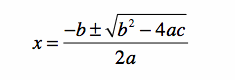
For example, putting numerical values for a, b, c  in the familiar formula

in order to find the numerical solutions to the quadratic equation

 is not algebra, it is arithmetic.

In contrast, deriving that formula in the first place is algebra. So too is solving a quadratic equation not by the formula but by the standard method of “completing the square” and factoring.

When students start to learn algebra, they inevitably try to solve problems by arithmetical thinking. That’s a natural thing to do, given all the effort they have put into mastering arithmetic, and at first, when the algebra problems they meet are particularly simple (that’s the teacher’s classification as “simple”), this approach works.

In fact, the stronger a student is at arithmetic, the further they can progress in algebra using arithmetical thinking. For example, many students can solve the quadratic equation  x2 = 2x + 15  using basic arithmetic, using no algebra at all.

Paradoxically, or so it may seem, however, those better students may find it harder to learn algebra. Because to do algebra, for all but the most basic examples, you have to stop thinking arithmetically and learn to think algebraically.

Is mastery of algebra (i.e., algebraic thinking) worth the effort? You bet — though you’d be hard pressed to reach that conclusion based on what you will find in most school algebra textbooks. In today’s world, most of us really do need to master algebraic thinking. In particular, you need to use algebraic thinking if you want to write a macro to calculate the cells in a spreadsheet like Microsoft Excel. This one example alone makes it clear why algebra, and not arithmetic, should now be the main goal of school mathematics instruction. With a spreadsheet, you don’t need to do the arithmetic; the computer does it, generally much faster and with greater accuracy than any human can. What you, the person, have to do is create that spreadsheet in the first place.  The computer can’t do that for you.

It doesn’t matter whether the spreadsheet is for calculating scores in a sporting competition, keeping track of your finances, running a business or a club, or figuring out the best way to equip your character in World of Warcraft, you need to think algebraically to set it up to do what you want. That means thinking about or across numbers in general, rather than in terms of (specific) numbers.

Of course, the need for algebra does not make it any easier to learn — though I think that spreadsheets can provide today’s students with more meaningful and fulfilling applications than problems about trains leaving stations or garden hoses filling swimming pools, that my generation had to endure. But in a world where our very national livelihood depends on staying ahead of the technology curve, it is crucial that we equip our students with the kind of thinking skills today’s world requires. Being able to use computers is one of those skills. And being able to use a computer to do arithmetic requires algebraic thinking.

In future postings I’ll describe the growth of algebra through the ages.